|
 |
|
The
first thing that some folks might have a hard time with is the name
"Bosque." Some might think, "It looks like 'mosque.' So it must
be pronounced 'bosk.'" Or they might think, "bo-skay." Well,
it's neither (or is it ni-ther?). Those from around this
county know it's pronounced "bos-kee."
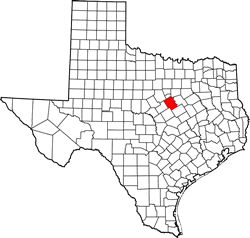
Bosque (did
I say it right?) County is not named for a "who;" it's named for
a "what." In 1721, Spanish explorer the Marques de San Miguel de
Aguayo was ambling his way to an East
Texas mission from San
Antonio de Bexar. Being an explorer, he wandered north off of
the Old
San Antonio Road and, well, went exploring.
De Aguayo camped near the Brazos River and another tributary and
looked around. He saw lots of trees. Since explorers are known for
naming things, he hailed the tributary "Bosque," which is Spanish
for "trees." When it came time to name the county, folks looked
at the Bosque River and figured Bosque
County was as good as any other name. So it stuck.
About 1830, George Erath was hired to survey the land for colonization.
Although he didn't have the title of explorer, he liked naming things,
too. While he was surveying near the ninety-eighth meridian, he
named two tributaries the Meridian Creek and the Meridian Knobs.
The name "Meridian" stuck, too, because when it came time to name
the county
seat, folks decided to call it just that.
Bosque County
is known for its Norwegian influence. After settling kinsmen in
seven other states, Norwegian Cleng Peerson set his eyes on Texas.
Once here, he urged fellow Norwegians in East
Texas to go west, but not too far. In 1854, he and other Norwegians
took advantage of the land give-away from the state and settled
Clifton,
Norse,
and Cranfills
Gap.
|
| The
year 1854 was also when Bosque
County was established. By that fall, a one-room log courthouse
was erected with Lowry Scrutchfield elected as county judge. Scrutchfield,
one of the original settlers in the county, had assisted Erath in
laying out the town of Waco.
Scrutchfield was county judge for four years, although much of his
time was spent warding off Indian attacks. The Comanches were keeping
the settlers busy by stealing whatever they could get their hands
on, from livestock to scalps. |
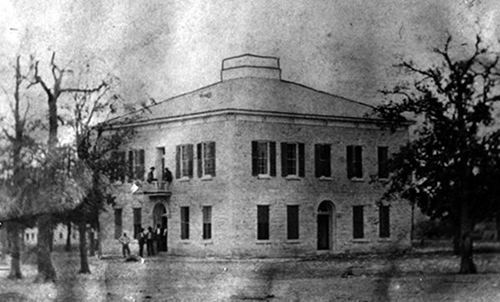
The 1875 Bosque
County Courthouse
Postcard
courtesy THC |
A
second courthouse was erected in 1860 but was
destroyed by fire in 1871. Then for about five years, court was held
off and on in a tent until a two-storied stone courthouse was erected
in 1875. That seat of justice lasted for a decade. Then, in
1886, a fight broke out over the possibility of building a new courthouse.
It was the Courthouse Party vs. the Anti-Courthouse Party, verbally
duking it out. The New Courthouse advocates sited the deteriorating
building and insufficient space. The Old Courthouse defenders spat
that a new courthouse, costing 60K, would break the county and raise
taxes. These rumblings culminated the day the courthouse was to be
demolished. Commissioner Tom Poole feared for his life as he rode
into town that day, having heard he'd be ambushed for voting for the
new courthouse. He found an angry mob gathered around the Courthouse
Square, armed with pistols and fury. Yet a shot was not fired, and
the courthouse was demolished.
Anti-Courthouse Party commissioners A. J. Walton and E. J. W. Odgen
refused to allow their names to be placed on the cornerstone of the
building, so only the names of Courthouse Party County Judge R. G.
Childress and commissioners Poole and John Goodman appear there. These
three men were subsequently voted out of office in the election of
1886 before the courthouse was completed. |
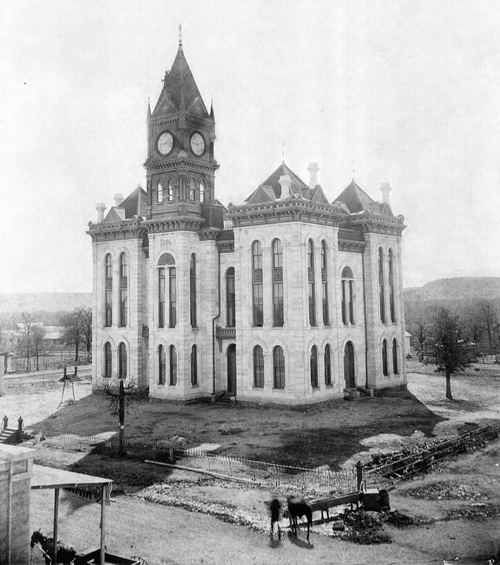 |
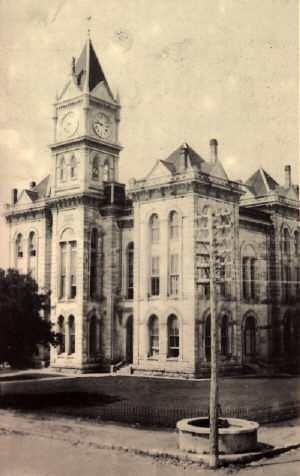
The 1886 Bosque
County Courthouse with tower and mansard roofs
Courtesy THC |
|
The
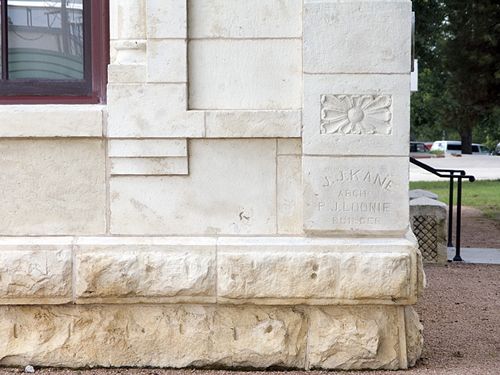
present Bosque County courthouse, completed the end of 1886,
is a Renaissance Revival courthouse designed originally by J. J.
Cane of Ft. Worth.
However, when he designed it, he had a Gothic tower with small turrets
on the corners above the east entrance.
The building is made from limestone quarried nearby. Roman arches
and heavy rusticated pilasters reflect the Renaissance Revival style.
Stone-carved fancy rosettes adorn the pilasters. The hipped roofs
over the corner pavilions, connected with mansard roofs, were originally
covered with metallic shingles in a diamond pattern.
|
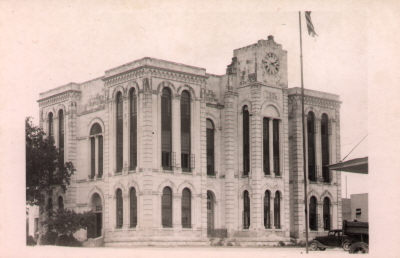
The 1886 courthouse
with clock tower
Postcard
courtesy www.rootsweb.com/ %7Etxpstcrd/ |
The 1886 Bosque
County Courthouse
Postcard courtesy www.rootsweb.com/ %7Etxpstcrd/ |
|
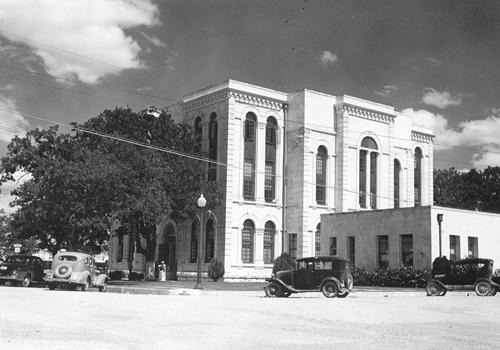
The Gothic tower
and these roofs were replaced with walls in 1935, as a result of
the Federal Emergency Administration of Public Works (WPA). That
renovation also resulted in an addition to the west side of the
courthouse.
|
The 1886 Bosque
County Courthouse as it appeared in 1939
Photo courtesy TXDoT |
|
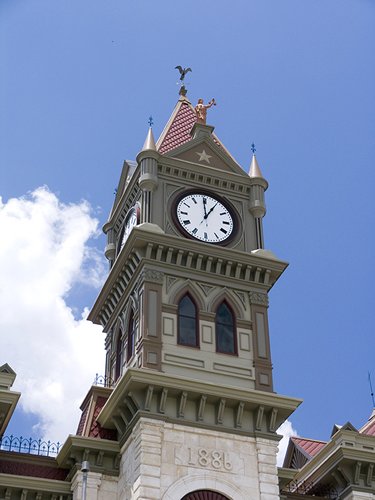
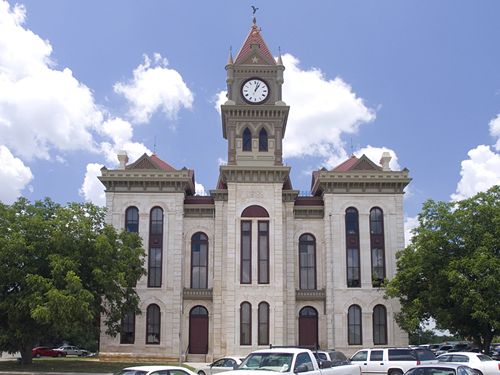
Bosque County
Courthouse Clock Tower Restored
Photo courtesy Sam
Fenstermacher, July 2007
|
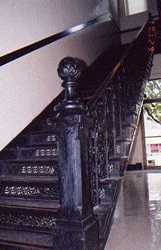
Cast-iron
stairs, made in Detroit, Michigan
Photo by Lou Ann Herda |
Copyright Lou
Ann Herda, Ed. D
September
2001
Much thanks to Tab Ferguson and Debbie Kibler at the Bosque County
Courthouse, and to Elizabeth Torrence with the Bosque County Historical
Commission.
References:
Bosque County Courthouse, by Elizabeth Torrence, Chr. Bosque Co. Historical
Commission (From the Bosque County Collection)
References and Additional
Reading |
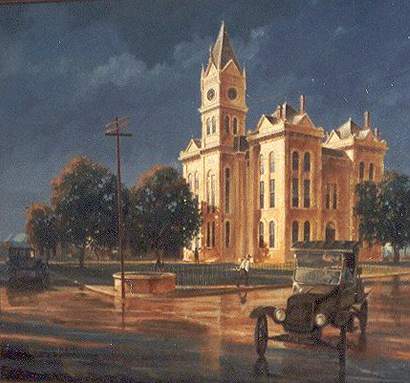
Oil painting
of the 1886 courthouse displayed in the Bosque County Bank across
from the courthouse. The artist is George Hallmark, a local artist
with a studio just outside of town.
- Terry
Jeanson, July 16, 2009
Photo courtesy Terry
Jeanson, October 2005 |
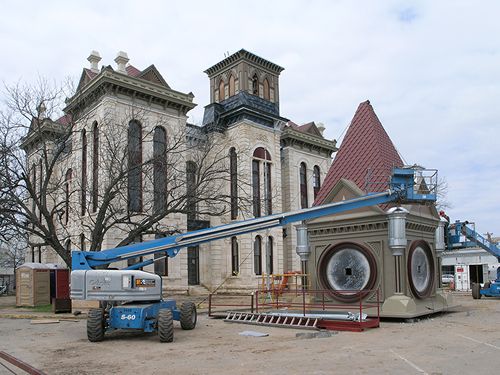
Bosque County
Courthouse Restoration
2007
|
Clock tower being
fabricated on the ground.
Photo courtesy Sam
Fenstermacher, March 17, 2007 |
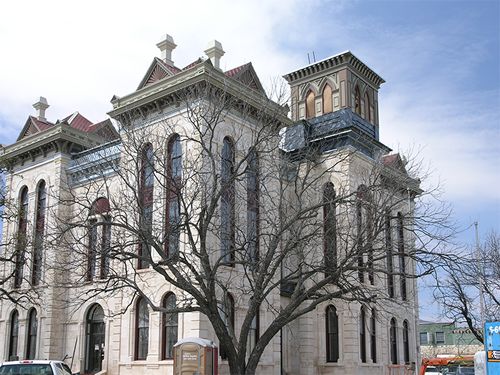
The courthouse
less the clock tower.
Photo courtesy Sam
Fenstermacher, March 17, 2007 |
|
|
 HOME
HOME