|
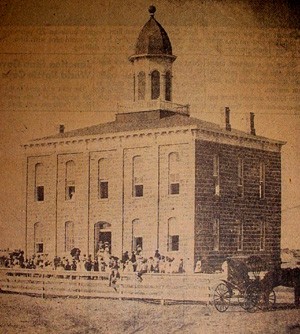
The former Tom
Green County Courthouse, later used as a school
Photo
from old newspaper clipping, no date or name of paper |
History
in a Pecan Shell
The short history of Benficklin has many of the elements that other
counties have built legends upon. A county seat rivalry, a rowdy frontier
fort, friendship beyond the grave and a disaster that killed many
of the inhabitants - it sounds a little bit like a lot of places.
If it was not for the name Ben Ficklin sounding like a bearded hermit
or a Charles Dickens character, the town's story would be familiar
to all Texans.
The Man Ben Ficklin
Born in 1827 and a graduate of the Virginia Military Institute, Ficklin
served as a Corporal in the Mexican War. He helped establish stagecoach
and mail routes across the U.S. and was involved in the creation of
the romantic (but short-lived) Pony Express. He served Virginia
during the Civil War where he became a European purchasing agent after
having served as the Virginia State Quartermaster. His involvement
in Texas started with his establishing
a mail route from Ft. Smith, Arkansas to California. He bought the
land where the town Ben Ficklin would later be. His untimely death
in 1871 was the result of choking on a fishbone at a dinner in Washington,
D.C.
The Town Benficklin
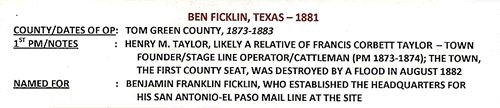
In 1868 Major Benjamin F. Ficklin
bought 640 acres around a spring that supplied Fort
Concho with its drinking water. This was about 5 miles South of
the fort. As the population of the area increased, a growing number
of people wanted to distance themselves from the fort and especially
the saloons and "businesses" that catered to it. Since it is was common
knowledge that it was difficult for drunks to stagger more than 3
miles, the decent element felt they were safe at the springs. It is
reported that the place was so tough that the officers of the fort
would confine themselves to indoor activities like board games and
letter writing, rather than risk an after-dark confrontation with
the enlisted men.
The town throve as a stop on the San
Antonio to El
Paso Mail Route. Major Ficklin
died (in the freak dining mishap previously mentioned) in 1871 and
left his interests to his friend F.C. Taylor. Taylor moved
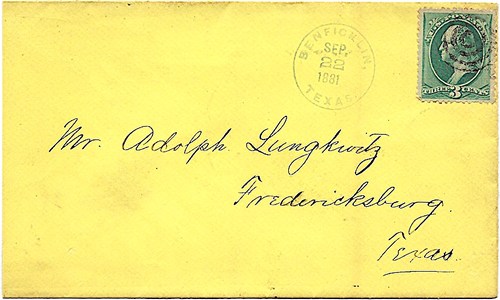
the stage stop a mile away and filed an application for a post office
with the name of his friend and benefactor Ben
Ficklin. It was accepted and Taylor became the first postmaster.
The town became the county seat in 1875 and Taylor died four years
later. |
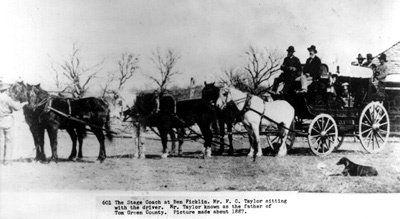 |
"The stage
coach at Ben Ficklin.
Mr. F. C. Taylor sitting with the driver. Mr. Taylor known as the
father of Tom Green County"
Photo
circa 1887, courtesy Hiram Joel Jacques |
San
Angela (as the town across the river from the fort was then known)
thought that they should be the county seat and they voiced their
desire. The situation may have turned into one of Texas' many "courthouse
wars" but Mother Nature settled the feud. She arranged a flooding
of the local creeks and rivers on the night of August 24th 1882. The
ground had already been saturated from a rare wet summer and a wave
of water hit the unsuspecting town while everyone slept. Most of the
town was washed away and 65 citizens - more than 10% of the population
- drowned.
With the demise of Benficklin, San Angela applied for a post office
and was told that authorities in Washington were appalled at their
bad Spanish. The postal authorities would accept Santa Angela or San
Angelo, but not San Angela. And so San
Angelo came into existence, even though it was named after Carolina
Angela, the wife of land developer Bartholomew J. DeWitt.
Benficklin Today
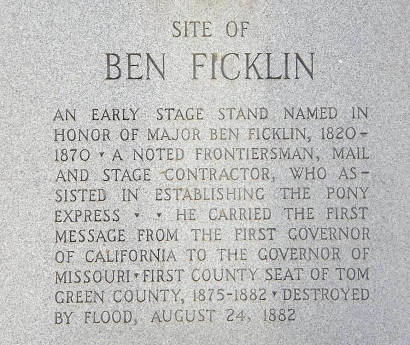
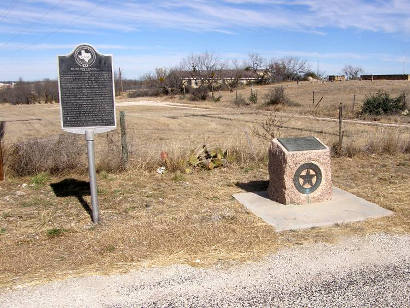
There is a marker for Ben Ficklin four miles South of San
Angelo on Hwy 277, even though this is not the actual site
(see letter from Mr. Bill Green
below). |
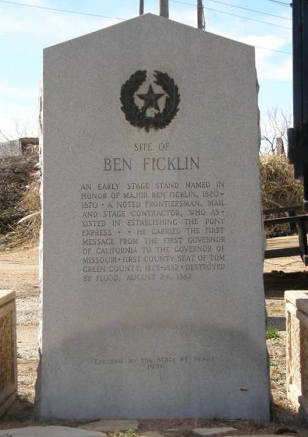 |
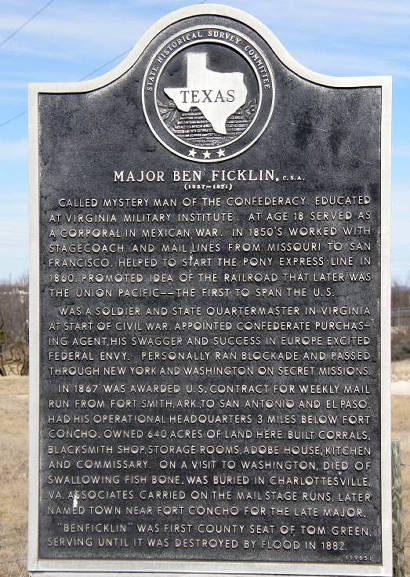
Historical Marker
on US 306 & Ben Ficklin Rd.
Photo courtesy Barclay
Gibson, January 2010 |
Historical Marker
Text
Major Ben Ficklin,
C.S.A.
(1827-1871)
Called Mystery Man of the Confederacy. Educated at
Virginia Military Institute. At age 18 served as a corporal in Mexican
War. In 1850s worked with stagecoach and mail lines from Missouri
to San Francisco. Helped to start the Pony Express Line in 1860. Promoted
idea of the railroad that later was the Union Pacific-- the first
to span the U.S.
Was a soldier and state quartermaster in Virginia at start of Civil
War. Appointed Confederate purchasing agent, his swagger and success
in Europe excited Federal envy. Personally ran blockade and passed
through New York and Washington on secret missions.
In 1867 was awarded U.S. contract for weekly mail run from Fort Smith,
Ark., to San Antonio
and El Paso.
Had his operational headquarters 3 miles below Fort
Concho. Owned 640 acres of land here. Built corrals, blacksmith
shop, storage rooms, adobe house, kitchen and commissary. On a visit
to Washington, died of swallowing fish bone. Was buried in Charlottesville,Va.
Associates carried on the mail stage runs, later named town near Fort
Concho for the late Major.
"Benficklin" was first county seat of Tom
Green, serving until it was destroyed by flood in 1882.
(1964) |
 |
|
The
Historical Marker is Not Where the Town Once Was
The town of Benficklin was not located where the park is, and the
proper way to spell the name of the town is as one word, even
though it was spelled both ways in the 1880s and since. I don’t
remember what the official post office name was. Francis Corbett
Taylor was a close friend of Ben Ficklin and supposedly said that
he didn’t want anyone to misunderstand which Ficklin the town was
named for, so he spelled it as one word.
When I was growing up during the 1950s, I lived on a farm south
of San
Angelo on the Christoval Road, near Benficklin. We frequently
drove around on Sunday afternoons. My grandparents had rented the
former site of Benficklin to graze cows during the 1920s and 1930s.
At that time, there were still some foundations located on the land. A
housing addition has been built on it now—in fact, the whole area
is covered with houses. It’s the low area along the river west of
the granite marker on the hill, on the west side of Benficklin Road. There
is an old dam called Metcalfe Dam on the South Concho immediately
west of the town’s location. I once drove Miss Mary Bain Spence,
whose mother was a sister Charles B. Metcalife, down a road into
the area where the town was located and to Metcalfe Dam. There wasn’t
a house anywhere at that time, probably about 1970. Her mother had
told her about the town many times. The Metcalfe family lived at
the stage station and some of them drowned in the Benficklin Flood
of 1882.
The Benficklin Stage Stand was where South Bryant Throughway crosses
the South Concho. In fact, part of the site must have been destroyed
to build the road. The marker for the stage stand at Benficklin
park was located in some trees near a public bathroom, west of the
Throughway by the road that crosses the old Benficklin Causeway. That
was where part of the stage stand was located, according to the
late Penrose Metcalfe who was the son of Charles B. Metcalfe.
- Bill Green, Curator of History, Panhandle-Plains Historical Museum,
July 30, 2009
|
Benficklin
Texas Forum
It is with
great interest that I recently read your article about Ben Ficklin.
In 1879, my greatgrandparents settled in Ben Ficklin and lived there
until the flood in 1882. After the flood, they established a ranch
on Willow Creek in the northern part of the county which later became
Sterling
City. Their names were Thomas and Ann Blezard Brennand.
|
|
|
|
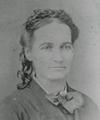
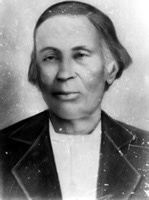
Thomas
Brennand (L)
Ann Blezard Brennand (R)
Photo courtesy Ann Brennand Martin Williams |
They
married in England in 1862 and came to America. They lived in Wisconsin
until 1879 when they moved to Ben Ficklin. Thomas had a ranch and
raised sheep and cattle. Thomas was the first County Commissioner
to represent Precinct No. 4 and was present as a member of the Commissioners
Court at its first sitting at the old Kildare Ranch in 1891.
I do not know where Thomas was the night of the flood. His son William
Henry Brennand, who was my grandfather, was in Midland.
When he heard about the flood, he got on his horse and rode all night
to see about his parents and sisters. When he got to Ben Ficklin,
he found his mother and sisters sitting on the roof of their house.
The only thing they were able to save was a pan of yeast. I guess
they knew if they survived they would need something to make bread
to eat.
His sisters names were Jennie and Annie Brennand. I know this story
is true because it was told to my father by Jennie who was one of
the girls.
- Very truly yours, Ann Brennand Martin Williams, February 25, 2004 |
|
|
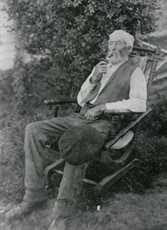
"My
great-great-grandfather, Tomas Jaques de Salazar (1800-1880), moved
to Ben Ficklin around 1871-72 with his family."
Photo
courtesy Hiram Joel Jacques |
|
My late father's
ancestors have deep roots in Ben Ficklin and Knickerbocker
history and also Tankersley.
My great-great-grandfather, Tomas Jaques de Salazar (1800-1880),
moved to Ben Ficklin around 1871-72 with his family.... - Hiram
Joel Jacques San Jose, CA , August 14, 2003
|
There's a house
out there used for the Stage Coach with stone walls 3 feet thick.
Are there any online pictures of that house? - Kelly A. Allison,
June 02, 2004
Good website.
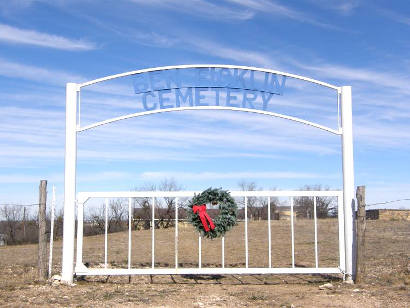
I am a decendent of Francis Corbett Taylor and Charles
Metcalfe. My mother, Mrs. Simms still owns the cemetery in which
the bodies of family members who drowned in the Ben Ficklin flood
and from the original cemetery were interred. Thank you for preserving
history in this manner. - Margie E. Kiser, San Angelo, 14/Nov/2002
I was born
in San
Angelo on Feb 6 1955. I enjoyed reading the story on Ben Ficklin.
I went there many times as I was growing up, and we had a lot of
family outings there. My parents are buried in San
Angelo and when I go to visit there graves, I always make a
trip to Ben Ficklin and remember the times we had there. I enjoy
the website. Thank you - Larry Kohutek, Grandview, Texas, 10/Mar/2002
|
 |
| Texas
Escapes, in its purpose to preserve historic, endangered and vanishing
Texas, asks that anyone wishing to share their local history, stories,
landmarks and recent or vintage photos, please contact
us. |
|
|
 HOME
HOME