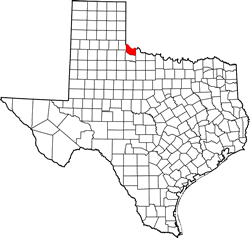
|
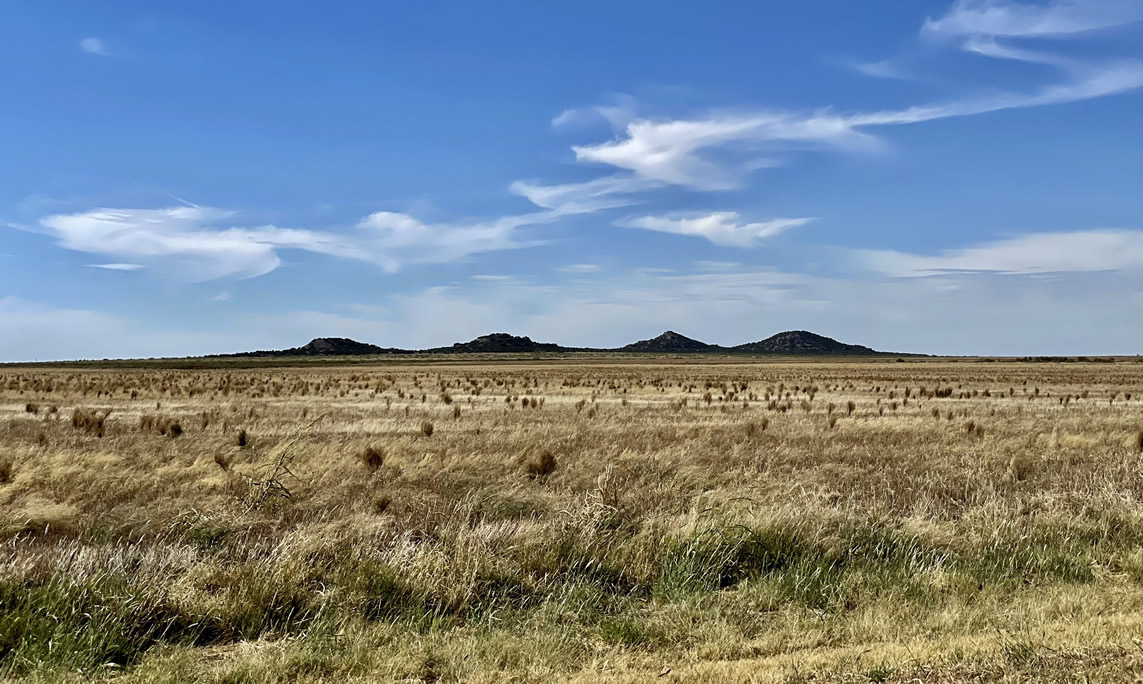
"[F]our
dolomite hills called Medicine Mounds"
"[O]ne mound contained springs, herbs and gypsum believed to
have medicinal properties." See historical markers below
Click on photo for larger image.
Photo courtesy Jonnie England, October 2021 |
History
in a Pecan Shell
Like the old saying goes: "If you find Medicine Mound - you had to
have been looking for it." It's not that it's difficult to find -
since it still appears on the state map - it's just that it is on
a long extended spur off of Highway 287. (FM 91 on the east and FM
1167) on the west. The mountains that comprise the mounds are visible
from Highway 287. There are actually four elevations that rise 200-250
feet above the landscape. These are natural mounds that were held
sacred by the Comanches.
The older Medicine Mound community that had been here prior to 1908
moved 2½ miles north to be alongside the tracks of the Kansas City,
Mexico and Orient Railway as it built through Hardeman
County.
Medicine Mound was once a vibrant town with a respectable population
of 500 served by 22 businesses. A devastating fire in the early 30s
(arson) destroyed most of the town. By the end of the Great Depression
the population was 210 and the town still had 6 buildings left.
Today there are three - about the same number of historical markers.
The Medicine Mound school merged with Quanah's
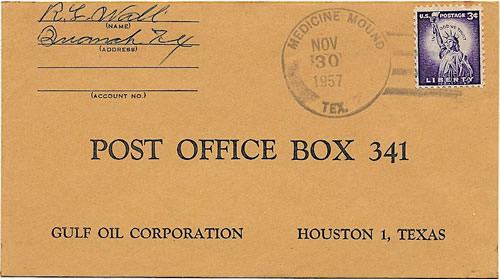
district in the mid-1950s - about the same time the post office closed.
|
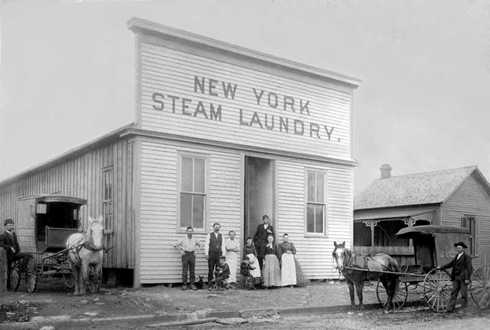 |
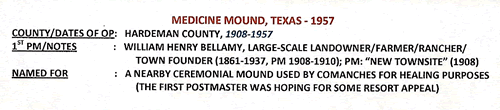
"New York
Steam Laundry"
Medicine Mound old photo courtesy Teresa Byrd, restored by John Bates |
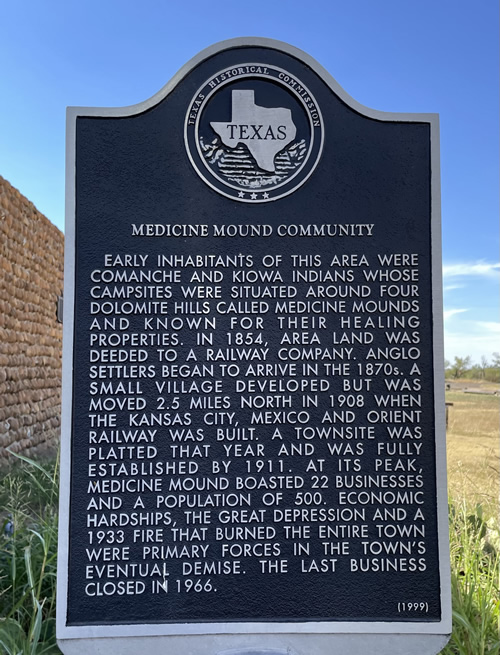
Historical Marker:
Medicine Mound
Community
Early inhabitants
of this area were Comanche and Kiowa Indians whose campsites were
situated around four dolomite hills called Medicine Mounds
and known for their healing properties. In 1854, area land was deeded
to a railway company. Anglo settlers began to arrive in the 1870s.
A small village developed but was moved 2.5 miles north in 1908 when
the Kansas City, Mexico and Orient Railway was built. A townsite was
platted that year and was fully established by 1911. At its peak,
Medicine Mound boasted 22 businesses and a population of 500. Economic
hardships, the Great Depression and a 1933 fire that burned the entire
town were primary forces in the town's eventual demise. The last business
closed in 1966.
(1999) |
Medicine Mound
Community historical marker
Photo courtesy Jonnie England, October 2021 |
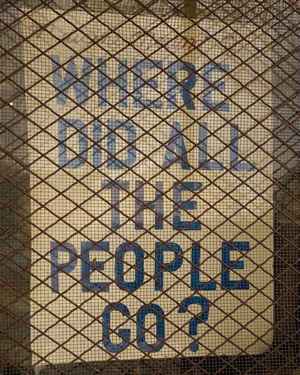
Where did all
the people go?
Photo courtesy John Bates, Nov. 2006 |
Medicine Mound,
Texas
Landmarks & Attractions:
|
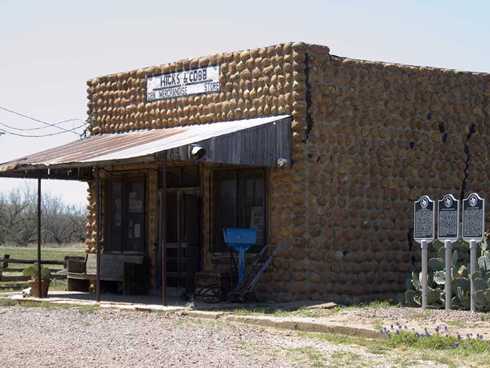
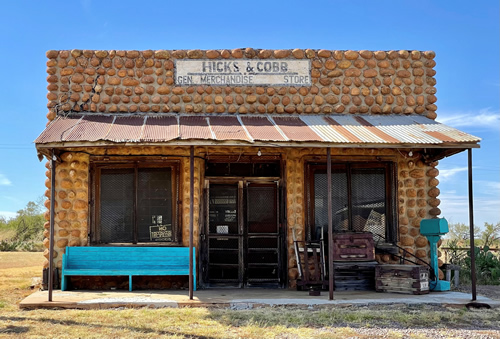
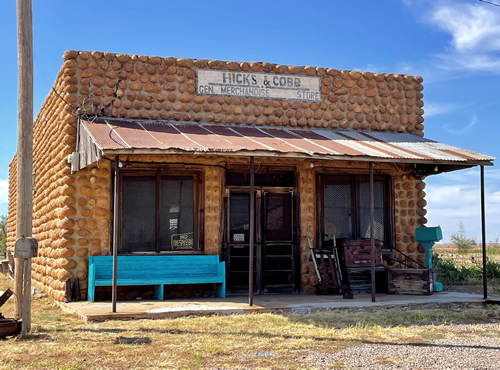
The 1933
Hicks & Cobb General Merchandise Store/
The Medicine Mound Museum
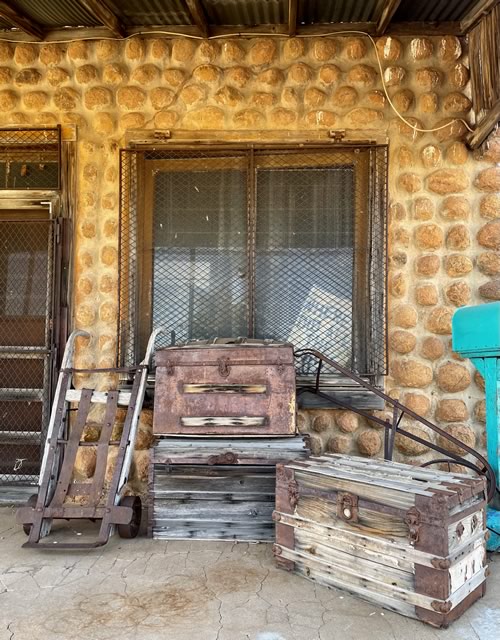
"The solid
granite round rocks were brought from Oklahoma and are actually prehistoric
gravel" - Myna Potts, store owner |
Hicks
& Cobb General Merchandise Store / Medicine Mound Museum &
three historical markers in 2006
Photo courtesy Geri Bates, Nov. 2006 |
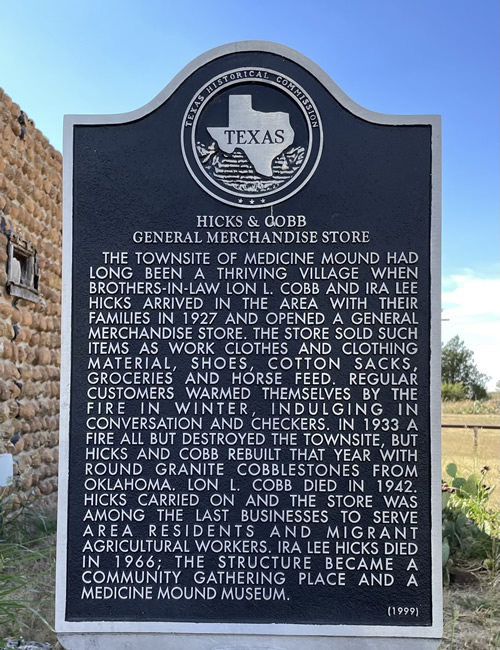
Historical Marker:
Hicks & Cobb General Merchandise Store
The townsite of Medicine Mound had long been a thriving village when
brothers-in-law Lon L. Cobb and Ira Lee Hicks arrived in the area
with their families in 1927 and opened a general merchandise store.
The store sold such items as work clothes and clothing material, shoes,
cotton sacks, groceries and horse feed. Regular customers warmed themselves
by the fire in winter, indulging in conversation and checkers. In
1933 a fire all but destroyed the townsite, but Hicks and Cobb rebuilt
that year with round granite cobblestones from Oklahoma. Lon L. Cobb
died in 1942. Hicks carried on and the store was among the last businesses
to serve area residents and migrant agricultural workers. Ira Lee
Hicks died in 1966; the structure became a community gathering place
and a Medicine
Mound museum.
(1999) |
Hicks & Cobb
General Merchandise Store historical marker
Photo courtesy Jonnie England, October 2021 |
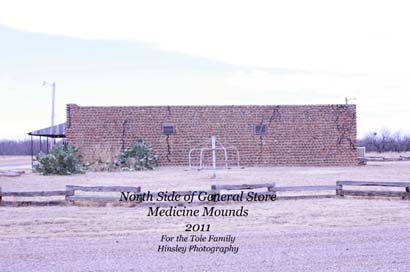
North side of
the General Store
Photo courtesy Randy Hinsley, February 2011 |
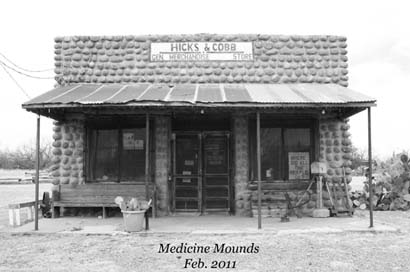
Hicks & Cobb
General Merchandise Store / Museum in 2011
Photo courtesy Randy Hinsley, February 2011 |
Hicks &
Cobb General Merchandise Store in 2021
Photo courtesy Jonnie England, October 2021 |
Hicks &
Cobb General Merchandise Store
Photo courtesy Jonnie England, October 2021 |
Hicks &
Cobb General Merchandise Store
Photo courtesy Jonnie England, October 2021 |
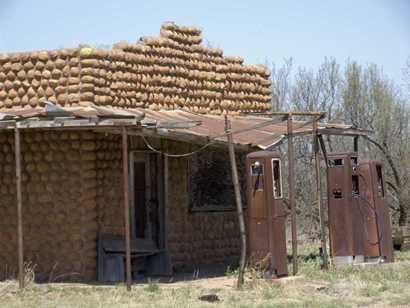
The 1933 W.W.
Cole Building
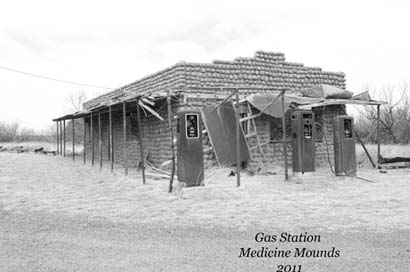
Medicine Mound Old Gas Station:
The building was
originally the bank, drugstore and post office |
The W.W. Cole
Building - The old gas station in 2006
Photo courtesy Geri Bates, November 2006 |
The W.W. Cole
Building, one of the two remaining building in 2011
Photo courtesy Randy Hinsley, February 2011 |
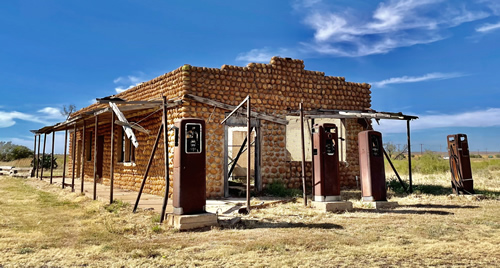
The W.W. Cobb
Building - Old gas station & gas pumps in 2021
Photo courtesy Jonnie England, October 2021 |
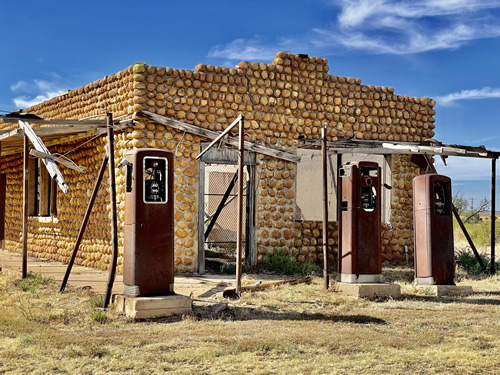
The W.W. Cobb
Building - Old gas station & gas pumps
Photo courtesy Jonnie England, October 2021 |
The W.W. Cobb
Building - Old gas station & gas pumps
Photo courtesy Jonnie England, October 2021 |
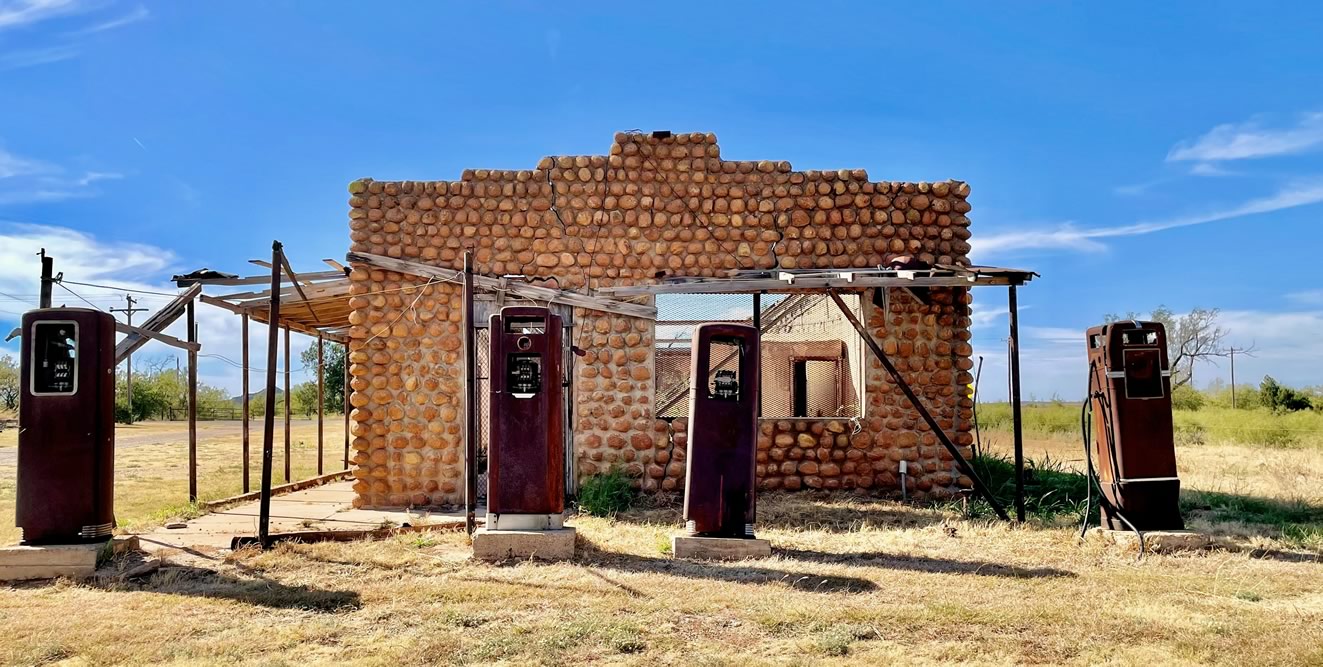
The W.W. Cobb
Building - Old gas station & gas pumps
Click on image to enlarge
Photo courtesy Jonnie England, October 2021 |
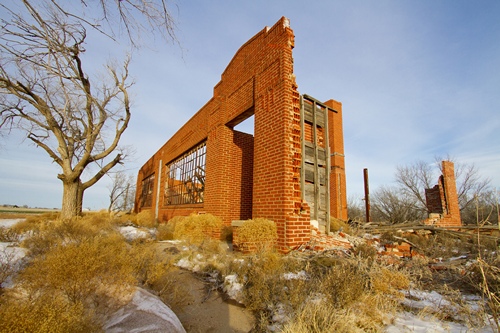
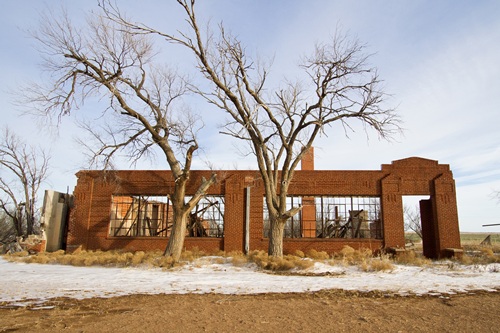
Medicine Mound
Schoolhouse Ruin:
|
Medicine Mound
Schoolhouse in 2012
"... about 50 yards off FM1167..."
Photo courtesy Clay Isbell, December 2012 |
Medicine
Mound Schoolhouse
"The building pictured is indeed the Medicine Mound School, which
was closed around the mid to late 1940's. it was used as a community
meeting place until the early 1970's (approximately). My father graduated
from this school in 1942. Thanks for sharing!" - Emily Stone,
March 12, 2013 |
Photographers'
Notes:
"I love
TexasEscapes.com! It's a fabulous resource and source of information
for so many of us Texas history buffs. THANK YOU for creating, maintaining
and updating the site! I was in Medicine Mound in October, 2021,
and things have changed a bit. I thought you might be interested
in these recent photos of the old school — what's left of it
— and the store and gas station. Thank you again for your dedication
and hard work to this marvelous site." Jonnie England
"Hi TE!
A few years ago I sent pics and a question about what ultimately
was identified as the schoolhouse in Medicine Mound. The pictures
were from a visit in 2012. I've returned a couple of times since
then, and I just visited on February 6th and was saddened by what
I saw. The entire top portion of the school has collapsed or has
been removed. I noticed the 2 trees that were in front of the building
are gone too, making me think that perhaps the removal was intentional
(maybe safety reasons?) or may have been cleaned up after a storm.
Anyway, it was still a shock to see this piece of history in worse
shape than before.
I've made it a habit to stop here when traveling to points further
west and will continue to do so. Hopefully things won't get any
worse. The rest of the town seems to be in the same shape as the
last few years" - Clay Isbell, February 12, 2016
"I've
traveled Hwy 287 between Decatur and Dumas Texas for years while
heading to destinations further west and never really ventured off
the main highway until recently. While searching for ghost towns
on your website, I came across Medicine Mound and had no clue the
town existed. Even as a child back in the 70's I often wondered
what the significance of the mounds were, but we always traveled
this highway as a means to get from point A to point B, never exploring
what lay beyond the blacktop of 287. Now as an adult and self-proclaimed
"back road junkie" and photographer I have planned trips around
what has become my favorite stretch of highway, and thanks to your
site I've been able to find hidden gems like the ghost town of Medicine
Mound.
I visited there just after Christmas 2012 and found the W.W. Cole
and Hicks & Cobbs buildings in pretty much the same condition as
I had seen on your website and others. But what I have not been
able to find is the story on the larger building which lies in ruins
about 50 yards off FM1167 and across the street from these two buildings.
It appears as though it was some type of school (but seems rather
large for the population statistics from the past). I would appreciate
if any of your readers may have some knowledge of its past and purpose.
Thanks for such an informative and intriguing website.
P.S. I have additional photos from Medicine Mound on my website
below in the "Ghost Towns and Old Mines of the West".
Clay Isbell Photography
www.clayisbell.smugmug.com
www.facebook.com/clayisbellphotography
- Clay Isbell, January 01, 2013
|
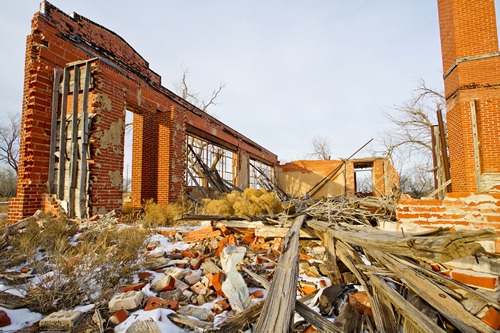 |
Medicine Mound
Schoolhouse ruins in 2012
Photo courtesy Clay Isbell, December 2012 |
The schoolhouse
in 2012
Photo courtesy Clay Isbell, December 2012 |
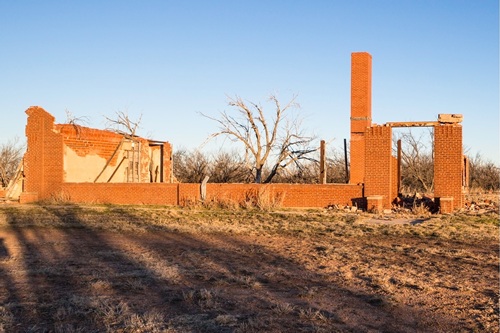
Medicine Mound
Schoolhouse ruins in 2016
Photo courtesy Clay Isbell, February 2016 |
Medicine Mound
schoolhouse ruins in 2021
Photo courtesy Jonnie England, October 2021 |
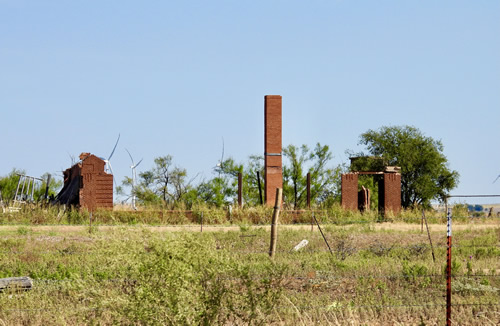
The schoolhouse
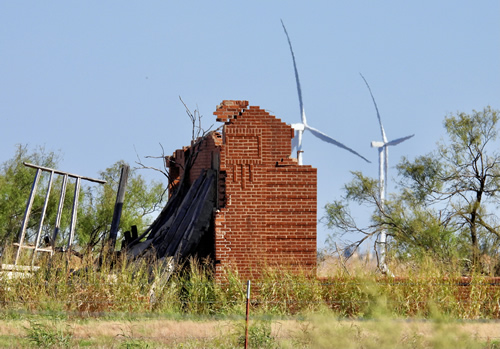
ruins with wind turbines nearby
Photo courtesy Jonnie England, October 2021 |
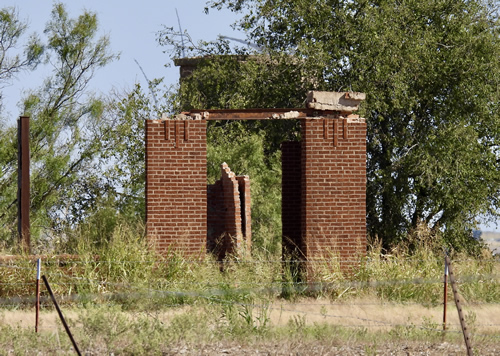
More of the
schoolhouse ruins
Photo courtesy Jonnie England, October 2021 |
"Texas'
Favorite Detour"
Could Medicine Mound be Texas' most interesting ghost town?
It is to the staff of Texas Escapes. Three reasons that come to mind
are: #1 It doesn't mind being called a ghost town. It is what it is
and it's certainly not pretentious (if it ever was). It is proud of
it's fascinating history - but while many former towns are proud -
Medicine Mound can boast having ... more
|
Historical Marker:
(S on FM 3295, junction of FM 1167):
Old Mounds
Cemetery
This cemetery served
residents of the original site of the community of Medicine Mound
in southeast Hardeman
County. The settlement took its name from mounds that rise abruptly
from the otherwise flat topography of the county; one mound contained
springs, herbs and gypsum believed to have medicinal properties. Established
by the late 1800s, the community consisted of Gobins' General Merchandise
Store, a school and a church. The cemetery was adjacent to the one-room
building used both as a schoolhouse and sanctuary. Most early residents
of the community participated in farming or ranching activities. Little
information is known about the early pioneers buried here. It is believed
that approximately nine burials took place in the community's early
history. Only one original gravestone, dated 1891, is preserved, and
it marks the burials of two infants, Smoot and Ford Kerley, children
of settlers J.C. and Ida Kerley. Other known burials are of Old Mounds
residents of Mexican descent. In 1908, the Kansas City, Mexico & Orient
Railway laid track two and half miles north of here. Residents moved
near the railroad and the previous community came to be known as Old
Mounds. In 1919, the school relocated as well, and soon the old
settlement was entirely abandoned, as was the cemetery. Today, this
burial ground is all that remains of Old Mounds, a testament
to the pioneering farmers and ranchers of this area and the Hispanic
families who lived and worked here.
Historic Texas Cemetery - 2006 |
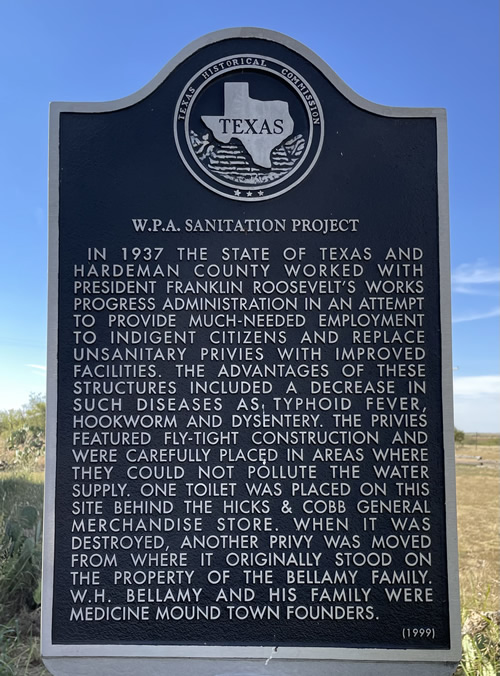 |
W.P.A. Sanitation
Project historical marker
Photo courtesy Jonnie England, October 2021 |
Historical Marker:
9 miles S of Chillicothe on FM
91. Structure reported destroyed Jun 2008
W. P. A. Sanitation
Project
In 1937 the State
of Texas and Hardeman
County worked with President Franklin Roosevelt's Works Progress
Administration in an attempt to provide much-needed employment to
indigent citizens and replace unsanitary privies with improved facilities.
The advantages of these structures included a decrease in such diseases
as typhoid fever, hookworm and dysyntery. The privies featured fly-tight
construction and were carefully placed in areas where they could not
pollute the water supply. One toilet was placed on this site behind
the Hicks & Cobb General Merchandise store. When it was destroyed,
another privy was moved from where it originally stood on the property
of the Bellamy family. W. H. Bellamy and his family were Medicine
Mound town founders.
(1999) |
Medicine
Mound Area Hotels :
Vernon
Hotels | Quanah
Hotels
Medicine Mound, Texas Forum
Subject: Growing up in Medicine Mound
I am now 62 years old and have fond memories of this now, ghost town.
I lived with my grandparents in a very small house there. Their driveway
(dirt and gravel) ran beside the Baptist church. My grandmother made
us clean up, if the lights came on at the church and off we would
go to praise God (and see our friends). My grandfather worked at the
only service station in town and drove the gas truck home at night.
I have fond memories of walking to see my grandfather at the station.
He would always buy my brother and I a 5 cent coke in a glass bottle
and a 3 - 5 cent candy bar. We loved to watch him fix flat tires in
the back room. He would use a patch on the inner tube and would light
it to seal the patch to the tube. We sometime got to go to what we
called Punkin City to pick up gas for the station in the gas truck
with him. We loved this as we sometimes got to eat at a cafe, which
was a real treat.
My brother and I went to school in Medicine Mounds until they closed
it. Then, we rode the bus to Quanah
and back every day. The school at the Mounds had two teachers. Mrs
Matthews taught the younger kids and the principal taught the older
group. I think we only had six grades, I am not sure about that. I
do remember the school as the most fun place. There was a wooden floor
gym and you would enter the bleacher area on one floor and look down
at the gym floor in like a basement area. I remember going to the
gym after hours to be with my uncle to watch him practice basketball
with his friends. While he was practicing, my brother and I loved
to hang over the balcony and drop to the floor below. We thought this
was very daring.
When I was young I remember hearing the foxhunts at night from our
yard. I think my grandmother said they were at the King ranch. I also
remember friends who told me of finding arrowheads on the mounds.
My grandmother would never let me go there.
The last time I went to the Mounds as we all called the town, everything
was all closed up. The school was still there looking very rundown.
The station brought back so many memories, it is hard not to cry,
even as I write this. - Nancy Sue Ashmore, October 16, 2006
Texas Escapes 400th Texas Ghost Town 12-1-06 |
 |
 |
Medicine Mounds
Click on photo to enlarge
Photo courtesy Ken
Rudine, July 2006 |
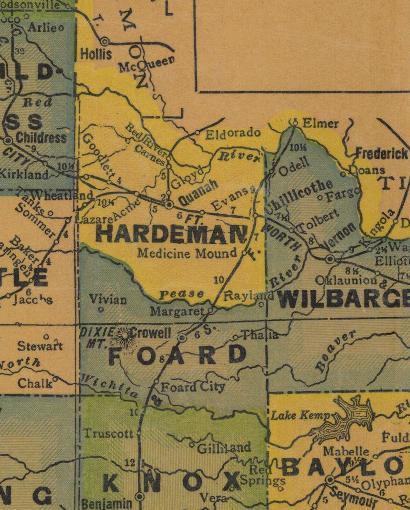
Hardeman
County 1940s map showing Medicine Mound on the railroad line
From Texas state map #4335
Courtesy
Texas General Land Office |
| Texas
Escapes, in its purpose to preserve historic, endangered and vanishing
Texas, asks that anyone wishing to share their local history, stories,
landmarks and recent or vintage photos, please contact
us. |
|
|
 HOME
HOME