|
 |
History
in a Pecan Shell
Born with the arrival
of the Gulf, Texas and Western Railroad, the name was borrowed from
the surname of J. W. Stevens’s wife’s family.
Westover had a school as early as 1913, and for a time operated its
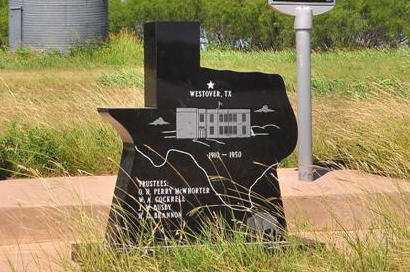
own ISD. The school is remembered in both a historical
marker and a headstone
complete with image.
The community was granted a post office in 1910 which managed to stay
open through 1957. No one knows when the town peaked – although the
number of students in the 1920s was around 170.
After WWII the
number of residents declined from nearly 100 to 61 for the 1970 census.
Twenty years later it had reached 58 and the 2000 census reported
a mere 18 people left.
See
Westover Today > Photo
Gallery
Westover Historical Marker
>
Westover School Historical Marker
> |
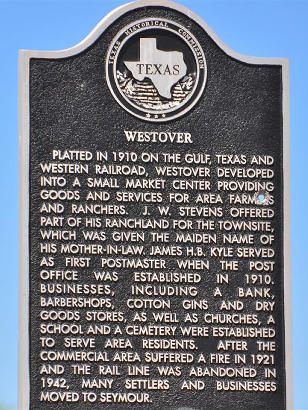
Westover Historical
Marker
Hwy 114 and Hale Rd.
Photo courtesy Gerald
Massey, June 2010 |
Historical Marker
Text
Westover
Platted
in 1910 on the Gulf, Texas and Western Railroad, Westover developed
into a small market center providing goods and services for area farmers
and ranchers. J. W. Stevens offered part of his ranchland for the
townsite, which was given the maiden name of his mother-in-law. James
H.B. Kyle served as first postmaster when the post office was established
in 1910. Businesses, including a bank, barbershops, cotton gins and
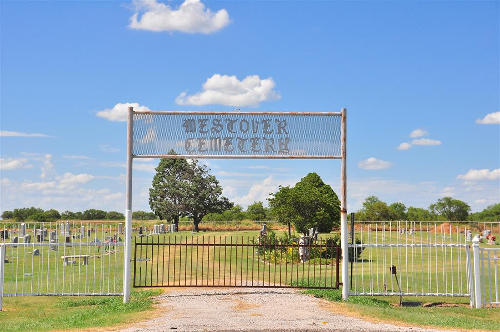
dry goods stores, as well as churches, a school and a cemetery were
established to serve area residents. After the commercial area suffered
a fire in 1921 and the rail line was abandoned in 1942, many settlers
and businesses moved to Seymour.
(2002) |
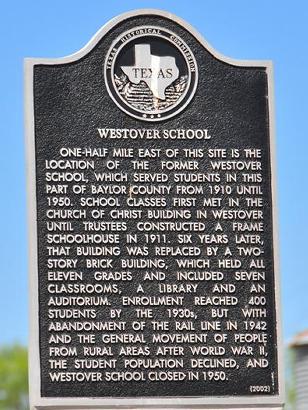
Westover School
Historical Marker
Hwy 114 and Hale Rd.
Photo courtesy Gerald
Massey, June 2010 |
Historical Marker
Text
Westover School
One-half
mile east of this site is the location of the former Westover School,
which served students in this part of Baylor County from 1910 until
1950. School classes first met in the Church of Christ building in
Westover until trustees constructed a frame schoolhouse in 1911. Six
years later, that building was replaced by a two-story brick building,
which held all eleven grades and included seven classrooms, a library
and an auditorium. Enrollment reached 400 students by the 1930s, but
with abandonment of the rail line in 1942 and the general movement
of people from rural areas after World
War II, the student population declined, and Westover School closed
in 1950.
(2002) |
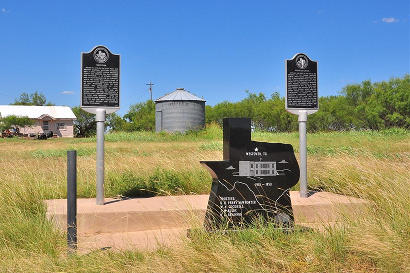
Westover Historical
Markers
Photo courtesy Gerald
Massey, June 2010 |
| Texas
Escapes, in its purpose to preserve historic, endangered and vanishing
Texas, asks that anyone wishing to share their local history, stories,
landmarks and recent or vintage photos, please contact
us. |
|
|
 HOME
HOME