|
 |
 |
History
in a Pecan Shell
Established in 1942 as an Infantry-training camp, Camp Howze once
covered 59,000 acres of Cooke
County land that was acquired from local landowners shortly after
Pearl
Harbor.
It was named to honor Major Robert E. Lee Howze, who had won the Congressional
Medal of Honor and had served during the Indian campaigns, the Philippine
Insurrection following the Spanish-American
War, and World War I.
The base was activated in August of 1942, and had a capacity of just
under 40,000 men.
Several hundred thousand men received their training here over the
course of the war and the camp later became a Prisoner of War Camp
for captured German soldiers.
An estimated $20 million was spend on the camp during it’s construction
and use, providing hundreds of jobs for Cooke
County residents.
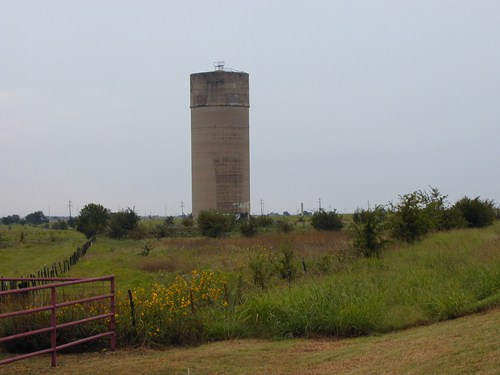
After the war, the camp, like most others, was deactivated. The buildings
were sold as scrap and today only the cement foundations, chimneys
and water towers remain.
In an interview with a former trainee, he recalled how demoralizing
it was to see German prisoners playing soccer while his unit was enduring
a forced march. “The war was over for them, but it hadn’t even started
for us.” |
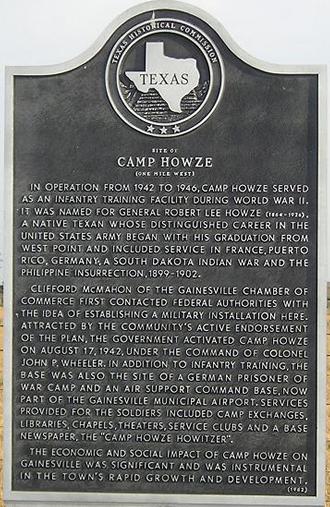 |
Historical Marker:
Site of Camp
Howze
(One mile west)
In operation from 1942 to 1946, Camp Howze served as an infantry training
facility during World
War II. It was named for General Robert Lee Howze (1864-1926),
a native Texan whose distinguished career in the United States Army
began with his graduation from West Point and included service in
France, Puerto Rico, Germany, a South Dakota Indian War and the Philippine
Insurrection, 1899-1902.
Clifford McMahon of the Gainesville
Chamber of Commerce first contacted Federal authorities with the idea
of establishing a military installation here. Attracted by the community's
active endorsement of the plan, the government activated Camp Howze
on August 17, 1942, under the command of Colonel John P. Wheeler.
In addition to infantry training, the base was also the site of a
German prisoner of war camp and an air support command base, now part
of the Gainesville Municipal Airport. Services provided for the soldiers
included camp exchanges, libraries, chapels, theaters, service clubs
and a base newspaper, the "Camp Howze Howitzer."
The economic and social impact of Camp Howze on Gainesville
was significant and was instrumental in the town's rapid growth and
development.
(1982) |
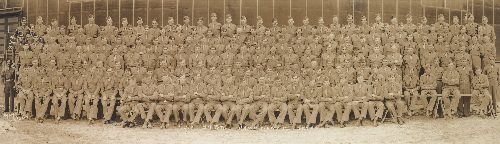 |
Subject: Camp
Howze Company Photo 3/22/1945
"My dad was at Camp Howze in 1945. He did make it back but passed
away in 1975. Here is a company
picture. I had it restored. Not sure how many of these are out
there. Please post so all can enjoy." - The Glenn D. Beard Family,
December 17, 2011 |
Plot Plan of
Camp Howze, dated November 7, 1942
Click here for large
image
Courtesy Thomas Reprographics, submitted by Len Brown October 17,
2014 |
Camp Howze
Today
Photo Gallery
|
 |
Photographers'
Notes:
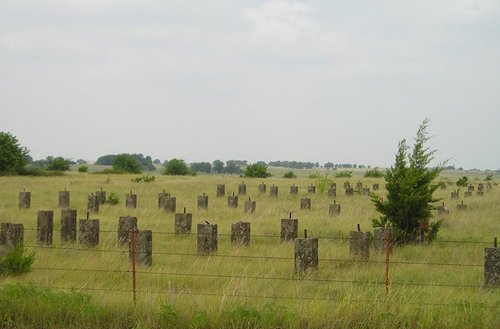
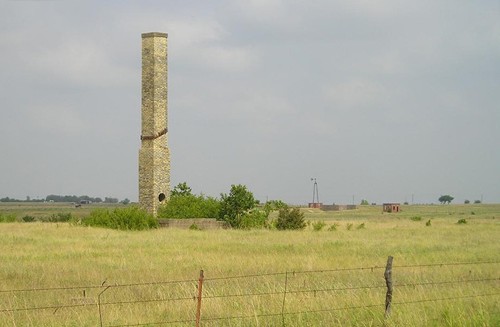
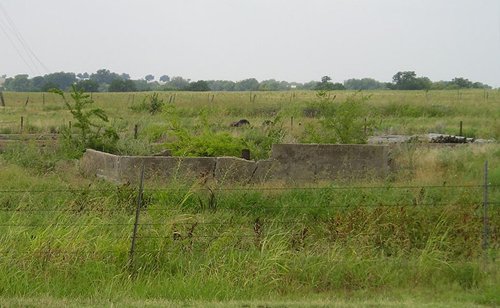
"These
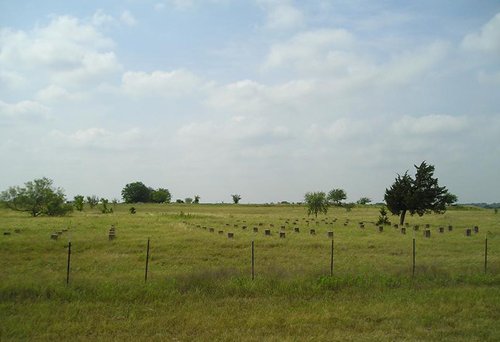
are the most visible remains of WWII
Camp Howze NW of Gainesville.
When the grass is low there are a great many small foundation supports
stretching across the countryside.
There are a number of small structures there but the water towers
stand out.
The camp was 59,000 acres (92+ sq mi).
From a story related by a friend whose parents owned a farm/ranch
within the camp boundaries. The army came in one day and said we're
buying your place and bull dozing your buildings, you have x days
to get out. They were allowed to repurchase the property following
the base closing if they wanted. Most had relocated and could not
afford to do so. Large chunks were made into two ranches."
- Mike
Price, September 27, 2007
"Turned
off for the roadside marker. It was quite eerie, and beautiful,
because the foundations looked like tombstones. I stopped and talked
to a couple of men working on the road, they said those foundations
were everywhere." - Sarah
Reveley, October 31, 2007
Book Area Hotels › Gainesville
Hotels
|
 |
 |
 |
A Letter from
a Former POW
Subject:
Your Camp Howze story and pix
To Sarah
Reveley
"I stumbled
onto your pictures and story concerning the German POW camp at Camp
Howze. Thanks for bringing back memories.
I was one of those POW’s at the camp from Mar 45 to Spring of 46.
There were 3 compounds for the prisoners, all next to each other.
Most of us worked on area farms, I had the fortune of working at
the Camp Howze laundry plant. In the Spring of 46 we were shipped
home, which turned out to be a journey to England where we had to
work for another few years as POW’s for the Brits.
In the mid 50’s, I with my family emigrated to the US. I had opportunity
to visit Camp Howze (or what was left of it) in the early 70’s during
a trip to Dallas. At that
time I met with and talked to a farmer who had built his homestead
where the camp was located before. He told me that I was the first
and only former
POW he knew of that ever came back. Thanks again for your story
and your pictures." - Wolf Weber, February 15, 2011
More on WWII
|
Camp Howze
Chronicles
Flagpole by Mike Cox
This story is about a mystery involving the flag staff that once
stood at Camp Howze, a sprawling World War II Army base at Gainesville...
|
|
|
 HOME
HOME