|
Plantersville
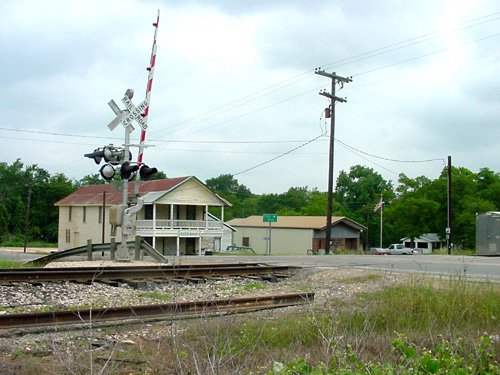
TE photo, June 2004 |
History in
a Pecan Shell
Settled
first by Arkansas and Alabamans in the 1830s, The town didn’t jell
until the early 1840s. A two-story Masonic building was built in the
early 1850s, using the familiar school below – lodge above design.
In addition to the school, two churches used the lodge building until
they could construct their own buildings. The community’s first store
opened before 1860 and a post office was granted in 1856.
The name (said acknowledge the antebellum planters) is credited to
Mrs. J. L. Greene. The community got a shot-in-the-arm in 1879, when
the Montgomery Central Railway connected Montgomery
and Navasota
with a stop at Plantersville. That railroad was bought by the Gulf,
Colorado and Santa Fe a few years later and the line expanded to Conroe
and Beaumont
to the east – and Somerville to
the west.
Russian, Pole and German Catholic immigrants created a need for a
Catholic church and in 1894,
St. Mary’s was organized. The 1890 population was 400 but for
some reason, it had fallen to a mere 150 by 1915. It rebounded somewhat
to 200 by the mid 1930s – and remained there for decades. It was still
200 in the late 50s and 212 for 1990 and 2000. |
| Plantersville,
Texas Historic Destinations: |
|
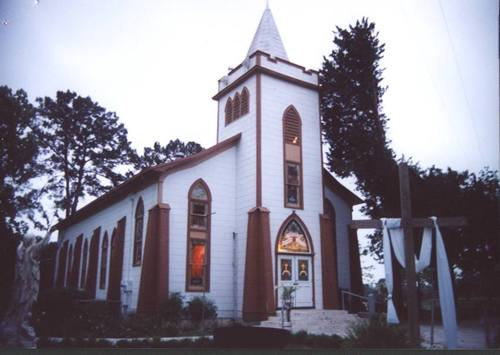
The
painted church in Plantersville |
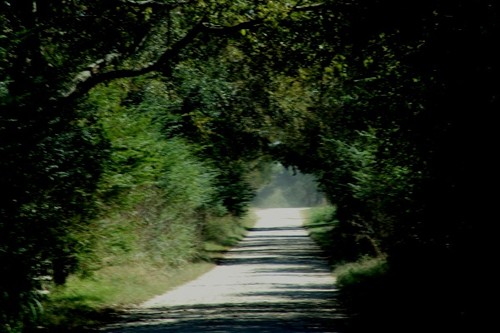
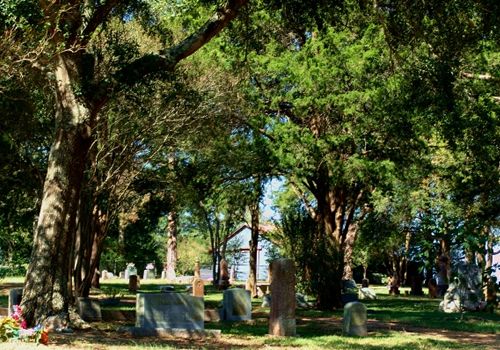
The spooky road
to the Plantersville Cemetery
Photo courtesy Ken
Rudine, October 2007 |
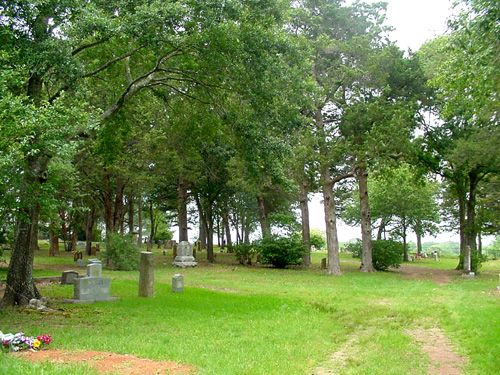
Plantersville
Cemetery
TE photo, June 2004 |
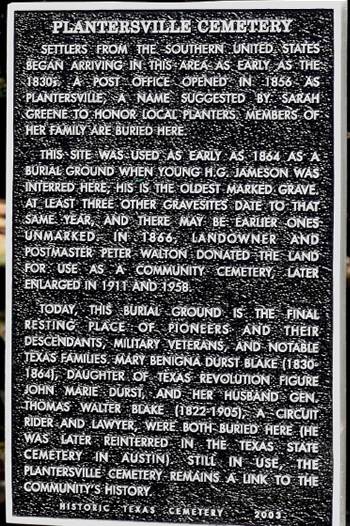
Historical
Marker: Cemetery Road off FM 1774
Plantersville
Cemetery
Settlers from the
southern United States began arriving in this area as early as the
1830s. A post office opened in 1856 as Plantersville, a name suggested
by Sarah Greene to honor local planters. Members of her family are
buried here.
This site was used as early as 1864 as a burial ground when young
H.G. Jameson was interred here; his is the oldest marked grave. At
least three other gravesites date to that same year, and there may
be earlier ones unmarked. In 1866, landowner and postmaster Peter
Walton donated the land for use as a community cemetery, later enlarged
in 1911 and 1958.
Today, this burial ground is the final resting place of pioneers and
their descendants, military veterans, and notable Texas families.
Mary Benigna Durst Blake (1830-1864), daughter of Texas Revolution
figure John Marie Durst, and her husband Gen. Thomas Walter Blake
(1822-1905), a circuit rider and lawyer, were both buried here (he
was later reinterred in the Texas
State Cemetery in Austin).
Still in use, the Plantersville Cemetery remains a link to the community's
history.
Historic Texas Cemetery - 2003 |
 |
Plantersville
Cemetery Historical Marker
Photo courtesy Ken
Rudine, October 2007 |
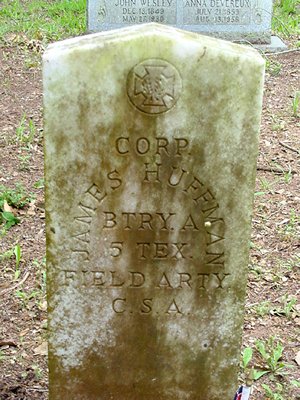
Civil War Tombstone
TE photo, June 2004 |
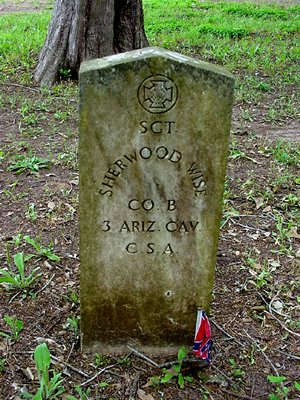
Civil War Tombstone
TE photo, June 2004 |
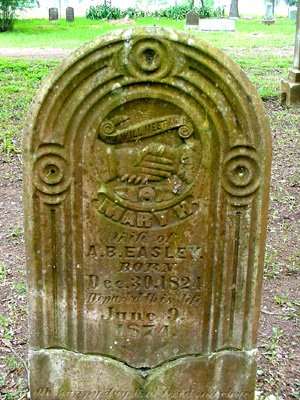
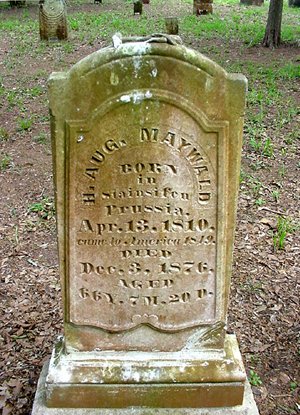
Prussian Tombstone
TE photo, June 2004 |
| Texas
Escapes, in its purpose to preserve historic, endangered and vanishing
Texas, asks that anyone wishing to share their local history, stories,
landmarks and recent or vintage/historic photos, please contact
us. |
|
|
 HOME
HOME