|
Books by
Jeffery Robenalt
|
|
Mexico’s
independence from Spain and the Mexican Constitution of 1824 brought
a new wave of American immigration to Texas.
Not only did the new settlers have to cope with the usual hardships
of beginning life in a new land, like building homes and planting
crops, but they also had to adjust to living in a country with a set
of customs and laws that were alien to their own.
Some colonists did their best to accept the conditions of settlement
established by the original Spanish government and the more recent
Mexican government, but many refused to make sincere efforts to become
loyal citizens of Mexico. Instead, they kept their own religions,
established their own schools, and even started their own newspapers.
Mexican officials began to worry that the colonists from the United
States were becoming too independent. |
|
|
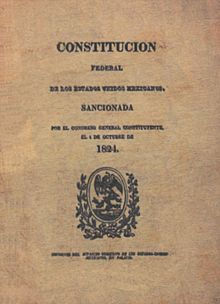
Constitution Of 1824
Wikimedia Commons |
Tensions also
began to arise within Mexico itself over the balance of power between
the state and national governments. Like the United States, Mexico
was organized into states, and the Constitution of 1824 was based
on the concept of states’ rights, where the majority of power resided
with the states. Prior to the Constitution, the central government
in Mexico City had held most of the power, and many Mexican leaders
felt that it should remain there. These Mexican nationalists feared
that too many American settlers were moving to Texas,
and that the combination of a growing population from the United States
and a strong government in the state of Coahuila y Tejas, might encourage
the colonists to seize the province of Texas and join the United States.
In
1825, problems arose in Texas over conflicting
land claims when Empresario Haden Edwards received a grant
of land near Nacogdoches.
When the land was surveyed, Edwards found that many people were already
living in the area, including Cherokees and descendents of Mexicans
who had settled there many years before. All empresarios were required
to honor existing land grants, but unfortunately for Edwards, his
was the only grant that had an appreciable number of existing settlers.
Edwards posted notices that people would lose their land unless they
came forward with proof of legal ownership. Most of the settlers had
no such proof. Instead, they complained to Mexican officials in Saltillo,
the capital of Coahuila y Tejas, and Governor Blanco sided
with them. Haden Edwards’ brother, Benjamin, wrote angry letters to
protest the decision.
Edwards’ problems escalated when he overturned the results of an election
for the alcalde of Nacogdoches.
Most long-time settlers voted for local resident, Samuel Norris,
but Edwards handed the election to his son-in-law. In response, a
now angry Governor Blanco reversed the election, cancelled Edwards’
land grant, and issued an order for Haden and Benjamin to leave Texas.
The Edwards brothers refused the order and signed an alliance with
the Cherokees. Forming the Republic of Fredonia, they declared
independence on December 16, 1826. Mexican authorities immediately
dispatched soldiers to suppress the rebellion. Stephen F. Austin,
worried that that the actions of the Edwards brothers would reflect
poorly on all Texas colonists, joined his militia with the Mexican
troops. The conflict ended peacefully in January 1827, when Haden
and Benjamin Edwards fled Texas before the combined force reached
Nacogdoches.
|
|
|
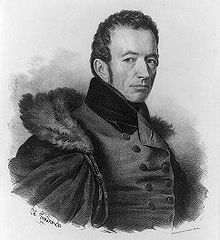
Joel Poinsett
Wikimedia Commons |
|
Though
the Fredonian Rebellion was quickly stamped out, Mexican
nationalists remained concerned that the increasing number of American
settlers pouring into Texas would lead
to an attempted takeover by the United States. This concern was
fueled when President John Quincy Adams sent Joel R. Poinsett
to Mexico City with an ill-fated and unsuccessful offer to purchase
Texas. Mexican officials, even those
in favor of states’ rights, were offended by the American belief
that Mexico would be willing to sell part of its territory.
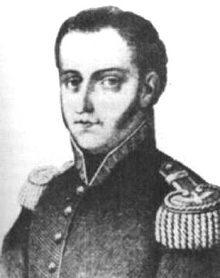
As a result, in 1828, authorities sent General Mier y Teran
to investigate conditions in Texas.
The General spent nearly a year touring the province and filed a
written report upon his return. In his report, Teran expressed concern
over the growing influence of the United States in Texas
affairs, stating that Anglo-American colonists now outnumbered Mexican
settlers by a ratio of 10 to 1. He further stated that many of the
Anglos ignored Mexican laws, especially the laws regulating trade
with the United States, and he made it clear that he felt Mexico
must regain control of Texas before
it was too late. “I am warning you to take timely measures,” he
reported. “Texas could throw the whole nation into rebellion.”
|
|
|
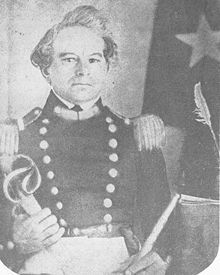
Manuel Mier y Teran
Wikimedia Commons |
|
Citing Teran’s
report, nationalist officials persuaded President Vicente Guerrero
to abolish slavery in Mexico. Since Anglos owned the majority of
the slaves, it was hoped that this measure would tend to slow the
flood of American immigration. However, the nationalists realized
that simply abolishing slavery would not be enough to gain control
of the situation.
Next
they enacted the Law of April 6, 1830. The law banned all
immigration from the United States, while encouraging Mexican and
European immigrants by offering them free land and money for their
passage. All empresarial grants not yet fulfilled were also canceled.
Other provisions banned the importation of slaves, established new
presidios manned in part by convict soldiers recently dredged from
Mexico’s prisons, and placed customs duties on all goods entering
Texas from the United States. In spite
of their intent, these provisions only served to anger the Anglo
colonists, and they felt ill-treated by the Mexican government.
The Law of April 6, 1830, also raised serious political questions
within Mexico between the centralists who favored a strong national
government and those who favored the states’ rights approach. Mexicans
who believed in states’ rights felt that the central government
had gone too far. Under the Mexican Constitution of 1824, the provisions
of the new law should have been enforced by each separate state
in its own way, not by the national government. This approach would
have allowed the state of Coahuila y Tejas to administer the law
in a more evenhanded manner, thus giving the Texas
colonists more of a voice in their own affairs. Therefore, instead
of resolving the growing crisis, the 1830 law actually caused the
level of tension to increase.
|
|
|
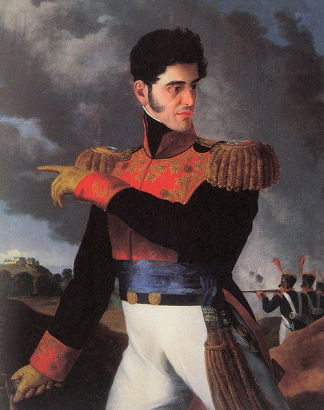
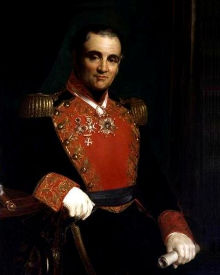
General Antonio Lopez de Santa Anna
Wikimedia Commons |
|
|
President Anastasio Bustamante
Wikimedia Commons |
|
Politician
and General Antonio Lopez de Santa Anna took advantage of
the unstable environment within the Mexican government to pose as
a proponent of states’ rights and launch a revolution against centralist
President Anastasio Bustamante. During the revolutionary
upheaval in Mexico, disturbances were also occurring in Texas,
and General Santa Anna sent Colonel Jose Mexia to conduct
an investigation. While he was in Texas,
Stephen F. Austin met with Mexia and convinced the Colonel that
the Texans supported Santa Anna’s efforts to preserve the Constitution
of 1824. Unfortunately, the Texans would soon find out that Santa
Anna was, in fact, a centralist who desired to become dictator of
all Mexico.
|
|
|
George Fisher
Wikimedia
Commons
|
|
Two
foreign-born Mexican officials, George Fisher and Colonel
John Davis Bradburn, also caused serious unrest among the Texas
colonists. Fisher was appointed to collect customs duties and put
a stop to the smuggling that was so common in Texas.
He required that all ship captains had to receive clearance papers
issued from the customs house at Anahuac
on Galveston Bay, no matter which port of entry they used. This
meant that many captains had to sail past their intended port, or
make a long overland journey to secure the proper papers. Although
most ship captains simply ignored the order, they still perceived
Fisher’s actions as unnecessary harassment.
Until 1830, the enforcement of many Mexican laws in Texas
had been overlooked by the government in order to promote the growth
of settlement. Now Colonel Bradburn was given the unenviable task
of enforcing all Mexican laws, including the provisions of the new
April 6 law. His haughty manner and strict enforcement methods angered
many settlers.
Bradburn even arrested Francisco Madero, a land commissioner
sent by the government of Coahuila y Tejas to issue land titles
to settlers living in Texas. This was
a foolish mistake because the April 6 law only prohibited granting
titles to new settlers coming in from the United States, not long-time
residents of the province. Bradburn also forced settlers to provide
free materials and labor for the construction of a new fort at Anahuac
and used the colonists’ slaves for public works programs.
|
|
|
William Barrett Travis
Wikimedia Commons |
|
In
May 1832, William Logan came to Anahuac
from the United States seeking two runaway slaves, but Bradburn
refused to release them without proof of ownership. Logan hired
Attorney William Barrett Travis to represent him and returned
to Louisiana for the necessary papers. After Logan’s departure,
Travis attempted to trick Bradburn into releasing the slaves and
was thrown into jail along with his law partner Patrick Jack,
when Jack protested Travis’s arrest. More than 150 settlers gathered
and demanded that Bradburn release the prisoners. He agreed, but
only if the Texans would disperse. The settlers pulled back to Turtle
Bayou, but Bradburn still refused to release Travis and Jack.
The settlers then sent John Austin to Brazoria
to bring back a cannon. While they awaited his return, the colonists
drafted a statement known as the Turtle Bayou resolutions. In the
resolutions the colonists pledged their loyalty to Mexico and stated
their support for Santa Anna, who they thought was in favor of the
Constitution of 1824. Before Austin returned to Turtle Bayou with
the cannon, Colonel Piedras, the commander of the Mexican
troops at Nacogdoches,
arrived in Anahuac.
After a brief investigation, he released Travis and Jack and dismissed
Bradburn from his command. Unfortunately, Colonel Piedras’s actions
came too late to prevent bloodshed.
Austin and his men had already loaded the cannon onto a small ship
at Brazoria
and sailed down the Brazos River to Velasco.
Not knowing that Travis and Jack had been released, the colonists
demanded passage, but Colonel Ugartechea the Mexican Commander,
refused. Fighting broke out, and for the first time Texans and Mexican
soldiers shot at each other. The Mexicans soon ran out of ammunition
and were forced to surrender, but ten Texans and five Mexicans were
killed at the Battle
of Velasco. Colonel Ugartechea and the remainder of the Mexican
soldiers were ordered to return to Mexico. The Texans continued
on to Anahuac
where they learned that the crisis had already been resolved.
In
October 1832, 56 delegates met in San
Felipe to draft a set of resolutions. After electing Stephen
F. Austin president of the convention and pledging support for the
Mexican Constitution of 1824, the delegates asked for the repeal
of the Law of April 6, 1830. In addition, they requested better
protection from the Native Americans and the creation of a public
school system. Finally, the delegates asked that the state of Coahuila
y Tejas be divided, so that Texas would
have its own government.
After the convention, Stephen F. Austin went to San
Antonio, but the right to petition the government was not guaranteed
under the Mexican system, and officials refused to send the resolutions
to Mexico City. While Austin was in San
Antonio, another convention was called on April 1, 1833, and
William Wharton was elected to lead the meeting. The delegates
adopted much the same resolutions as the earlier convention, but
this time they also drafted a constitution for the new Mexican state
of Texas.
Drafting a constitution was a serious step toward independence,
and even some of the Mexicans who sympathized with the Texas
cause felt that the action was in direct defiance of the government.
This time Stephen F. Austin personally traveled to Mexico City to
deliver the Texans’ resolutions. The trip took nearly three months,
and when Austin reached the capital in July 1833, he found the city
in turmoil after a successful revolution by Santa Anna and a widespread
cholera epidemic.
|
|
|
Valentín Gómez Farías
Wikimedia Commons |
|
Since Santa
Anna was temporarily out of the capital successfully concluding
his revolution, Austin presented the resolutions to Vice President
Valentin Gomez Farias, who was in charge during Santa Anna’s
absence. However, Farias was unwilling to accept responsibility
for dealing with such an important issue, and he was slow to address
the Texans’ problems. After several weeks, Austin grew impatient,
and in October he wrote a letter to the Texas
delegates, suggesting that they go forward and establish a new state
government that would make Texas separate
from Coahuila, but still remain loyal to Mexico.
The following month, Austin met with Santa Anna, who unexpectedly
agreed to most of the Convention’s resolutions, although he rejected
the request for separate Texas statehood.
Austin left Mexico City on December 10, bound for home, but he was
arrested when he reached Saltillo. Mexican agents had intercepted
the letter he wrote to the Texas delegates,
and Farias felt that it challenged the authority of the Mexican
government. Accused of treason, he was either imprisoned or held
under house arrest for much of the following two years.
Texas remained calm during Stephen
F. Austin’s long confinement, though tensions between the Mexican
Government and the Anglo-American settlers remained high. Then just
before Austin’s release in the summer of 1835, new events fanned
the flames of unrest. Finally showing his true colors, General Santa
Anna dismissed the Mexican congress and had a new constitution written
that made him the virtual dictator of Mexico. His first act was
to send his brother-in-law, General Martin Perfecto de Cos,
north with sufficient troops and orders to deal harshly with any
sign of rebellion. The stage for total revolution was now set. All
that was lacking was the spark to ignite the powder keg.
© Jeffery
Robenalt,
November 1, 2011 Column
jeffrobenalt@yahoo.com
More "A Glimpse of Texas Past"
|
References
(The Rising Tide of Revolution)
Barker, Eugene
Campbell (1985), The Life of Stephen F. Austin, Founder of Texas,
1793-1836, Austin, TX: University of Texas Press, ISBN 0-292-78421-x
originally published 1926 by Lamar & Burton
Cantrell, Greg
(1999), Stephen F. Austin: Empresario of Texas, New Haven,
CT: Yale University Press, ISBN 978-1-0-7884-1657-6
Davis, William
C. (2006), Lone Star Rising, College Station, TX: Texas A7M
University Press, ISBN 9781585445325 originally published 2004 by
New York: Free Press
Edmondson,
J. R. (2000), The Alamo Story-From History to Current Conflicts,
Plano, TX: Republic of Texas Press, ISBN 1-55622-678-0
Ericson, Joe
E. (2000), The Nacogdoches Story: an informal history, Heritage
Books, ISBN 978-0-7884- 1657-6
Fehrenbach,
T. R. (1968), Lone Star: A History of Texas and the Texans,
Macmillan, ISBN 0-20- 032170-8
Fowler, Will
(2009), Santa Anna of Mexico, Lincoln, NE: University of
Nebraska Press, ISBN 9789803226388
Henderson,
timothy J. (2007), A glorious defeat: Mexico and its war with
the United States, Macmillan, ISBN 9780809061204
Henson, Margaret
Swett (1982), Juan Davis Bradburn: A Reappraisal of the Mexican
Commander of Anahuac, College Station, TX: Texas A&M University
Press, ISBN 9780890961353
Morton, Ohland
(July 1943), "Life of General Don Manuel de Mier y Teran," Southwestern
Historical Quarterly (Texas State Historical Association) 47
(1), retrieved 2009-01-29
Rowe, Edna
(April 1903), "The Disturbances at Anahuac in 1832," Southwestern
Historical Quarterly (Texas State Historical Association) 6
(4): 265-299
Weber, David
J. (1982), The Mexican Frontier, 1821-1846: The American Southwest
Under Mexico, University of New Mexico Press, ISBN 9780826306036
|
|
|
 HOME
HOME