|
The Naming
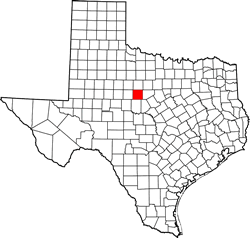
of Baird and County
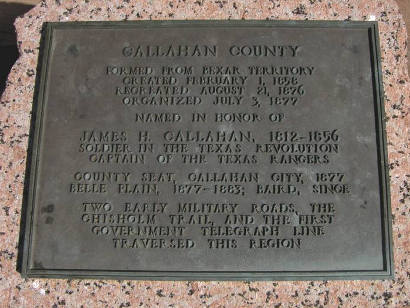
The County was
named after James Callahan, a survivor of the Massacre
at Goliad.
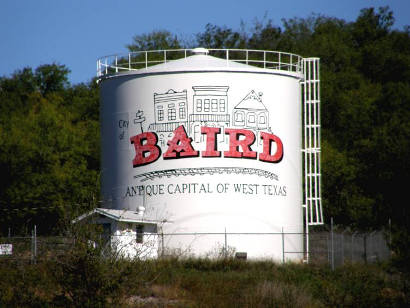
Baird was named after one Matthew Baird, who various sources list
as either a railroad director, lawyer, surveyor, yodeling brakeman
or any combination thereof. Maybe he was a yodeling lawyer. |
 |
|
History
in a Pecan Shell
Still waters run deep. Don't let the town's current tranquility
fool you.
This place has survived a fire (1884), a tornado (1895), cattle
drives, hard winters (notably 1884-85), long droughts (drouths)
(1886-87) and a spectacular three locomotive collision caused by
a runaway engine in 1907. This incident may have given the Katy
railroad their idea for The
Crash at Crush. By the time the railroad in Baird was informed
about the loose locomotive, there was no time to wake people and
sell tickets. Baird had a roundhouse and maintenance shops for the
T & P.
What goes around comes around (unless it's a runaway locomotive).
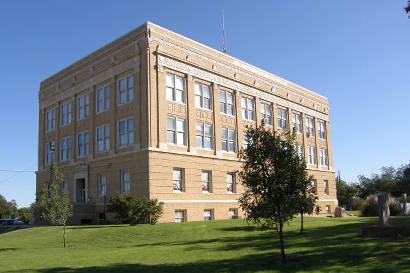
Callahan County's
Seat of Government was originally in Belle
Plain, about 3 miles south. They had it all: a college (Belle
Plain College), a courthouse and a spanking new stone jail.
When the railroad come through, the newspaper and main businesses
moved to Baird and the people then wished they had made the jail
out of something much lighter. They dismantled it, numbered the
stones, and then reassembled it in its present location (100 W.
5th Street in Baird).
Ironically, it was Belle
Plain that caused the demise of Callahan
City, drawing away major businesses and population when Belle
Plain became the County Seat.
Callahan
City's cemetery is about all that's left of that town, while
Belle
Plain still has ruins of the College buildings.
|
Baird, Texas
Landmarks & Attractions
|
Photographer's
Note:
"There is something unique in every block." - Barclay
Gibson |
|
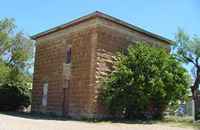
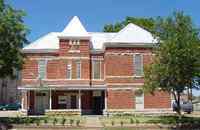
The Old Callahan
County Jail
Originally in Belle
Plain.
When the railroad come through, and Belle
Plain businesses moved to Baird, the townspeople dismantled
their new county jail, numbered the stones, and then reassembled
it at its present location. (100 W. 5th Street)
|
|
The New Jail
in Baird
"I recently reviewed your site and was very interested in the
information about the New Jail in Baird.
My mother (Nora A. Reed Bridges) was born in that jail in 1897.
Also, two brothers were born there. My maternal grandfather, J.M.
Reed was the jailer and my grandmother cooked for the inmates. They
moved from there to the Haskell
area where my grandfather was a blacksmith and deputy sheriff."
- James R Bridges, June 04, 2005
|
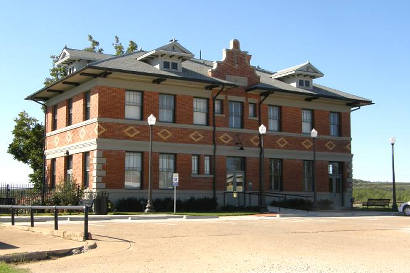
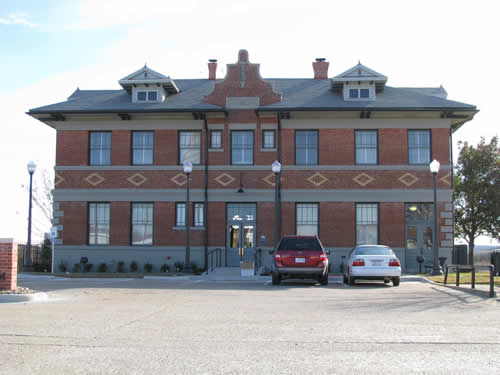
Baird Texas
&
Pacific Depot Visitor Center and
Transportation Museum
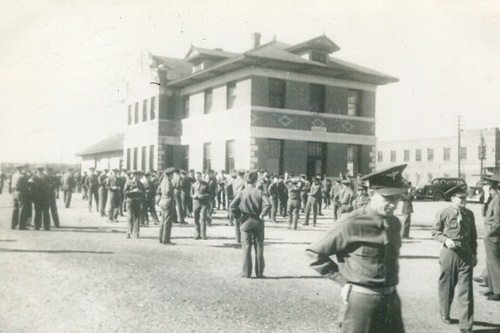
The Texas and Pacific Depot c. 1911
One of the larger ones on the former T & P route.
The T & P had depots from Marshall
to
Sierra Blanca,
where it merged with the Southern Pacific |
 |
|
Aviation
cadets take a break in front of the T & P Depot at Baird in January
of 1943
I found the [above] photo in my Dad's World
War II album. He was an aviation cadet on a transcontinental
troop train that stopped in Baird in January 1943. Baird was a rest
stop for these guys after long train trips from the east. I am not
sure how long these troop trains stopped in Baird, but it must have
been welcomed by the thousands of GI's who were being transported
long distances in crowded conditions. In my Dad's case, he documented
the trip through some great photos, not just of Baird but pointing
his camera out of the Pullman window to show the steam engine chugging
across the Mississippi River at New Orleans and entering the Mojave
Desert in California.
Most of the GIs in the photo were in pre-flight training enroute
to the Santa Ana, California training base. You can see that the
GI in the foreground is wearing the aviation cadet wings on his
cap or "cover". This was their uniform until they completed training
and were commissioned as Second Lieutenants and awarded their official
wings. In WWII,
Santa Ana was both a pre-flight training base and holding area for
aviation cadets until they were ordered to advanced training bases.
In my Dad's case, he was slotted to Bombardier pre-flight training
in Santa Ana (mostly academic non-flying work) and then advanced
flight training at Kirkland Field, NM. There was still two and one-half
years of tough combat ahead and I wonder how many men in the photo
survived the war. - David Schoeck, Dana Point, CA, January 09, 2008
See World War
II
|
 |
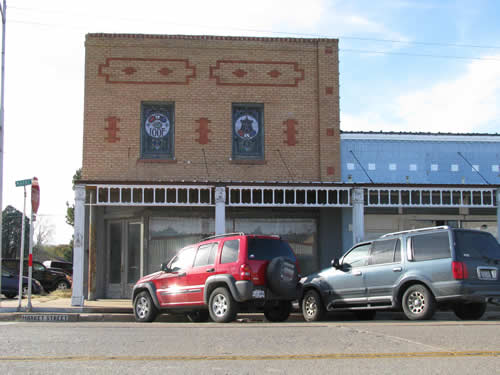
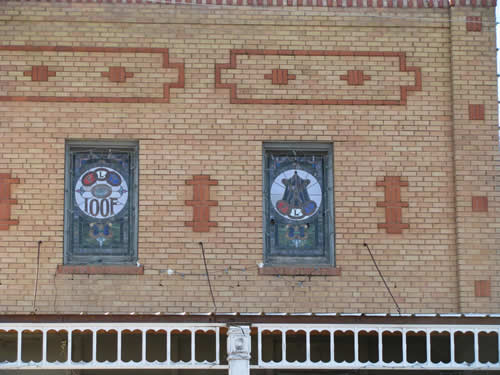
Odd
Fellows Building
Photo courtesy Mike
Price, December 2007
|
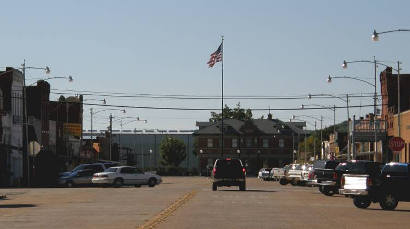
Looking south
on Market Street
Photo courtesy Barclay
Gibson, October 2009
|
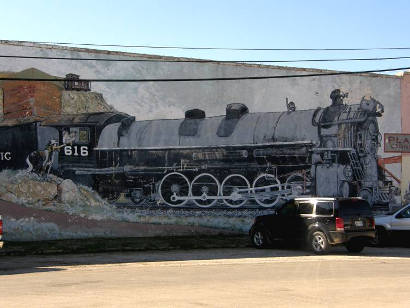
The
Baird Locomotive Mural
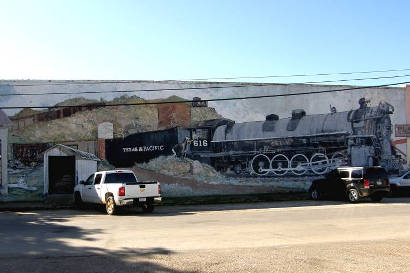
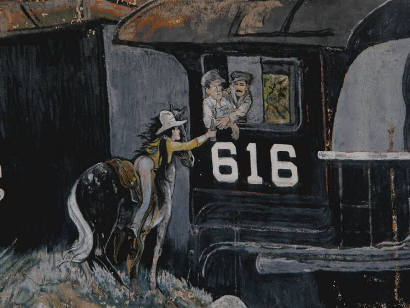
These two pickups conveniently provide scale for this well-executed
mural. Trains are freqently mural subjects - but seldom are they painted
life-size.
Photo courtesy Barclay
Gibson, October 2009 |
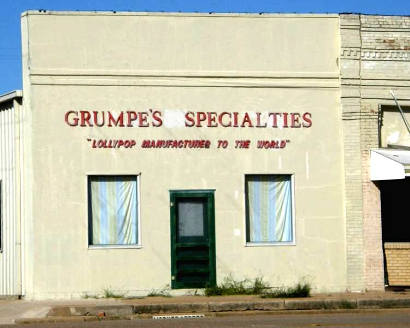
Grumpe's - "Lollipop
Manufacturer to the World"
Photo courtesy Barclay
Gibson, October 2009 |
| Texas
Escapes, in its purpose to preserve historic, endangered and vanishing
Texas, asks that anyone wishing to share their local history, stories,
landmarks and recent or vintage photos, please contact
us. |
|
|
 HOME
HOME