|
Books by
Jeffery Robenalt
|
|
| The
attempts of the Filibusters to
wrest Texas from the hands of the Spanish,
and later the Mexicans, were largely unsuccessful, however, their
efforts focused the attention of many Americans on a vast and empty
land that was ripe for settlement. One of the first men to take notice
was Moses Austin, an American-born Spanish citizen. Austin
had originally emigrated to New Madrid in Spanish Louisiana from Connecticut
to operate a lead mine and assist in the settlement of 30 families
from the United States. For twenty years, Austin prospered in Louisiana,
as the territory was first reacquired by France and then sold to the
United States in 1803. However, with the Panic of 1819, he was suddenly
faced with financial ruin and a burdensome debt. |
|
To the south
lay the Arkansas country, just beginning to open up to settlement,
but Austin was neither a homesteader nor a cotton planter. His forte
was business, and he felt sure that he could repeat his former success
of bringing settlers to New Spain by again following the Spanish
frontier; this time to Texas. After
discussing his decision to become a Texas land empresario with his
son, Stephen, Moses Austin set out on the 800 mile ride to
San Antonio de Bexar.
Upon entering the old Spanish town in the fall of 1820, Austin found
an atmosphere rife with ill feelings toward all Anglo-Americans.
General Arredondo, Spanish Commandant of the Eastern Provinces,
had recently crushed Dr. James Long’s last attempt at filibuster,
and he gave Governor Martinez explicit orders that no Americans
were permitted to enter Texas on any
pretext. Under these circumstances it was not surprising that Governor
Martinez refused to speak with Austin about his plan when he learned
the man was an American. In spite of producing papers proving that
he had been a Spanish citizen for many years, Austin was ordered
to leave Bexar before sunset or he would be placed under arrest.
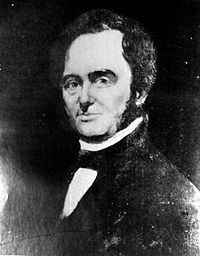
Moses Austin left the governor’s palace, a near broken man, his
dreams shattered, but he was to find salvation in the form of an
old friend, Felipe Enrique Neri, the Baron de Bastrop. The
Baron had emigrated from Holland during the turmoil of the French
Revolution and founded the town of Mer Rouge in Louisiana. Later,
when France reacquired Louisiana, the Baron, preferring to remain
a Spanish citizen, moved to Texas and
founded the settlement of Bastrop.
The Baron de Bastrop was always welcome at the governor’s palace,
and even General Arredondo liked him and appreciated his political
stance in behalf of the Royalists.
|
|
|
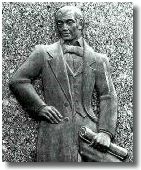
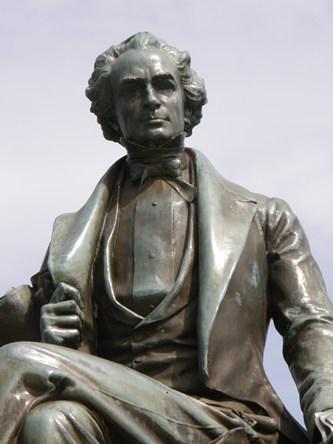
Baron
de Bastrop Monument
Wikipedia
|
|
Bastrop agreed
to serve as Austin’s agent and help present his old friend’s petition
requesting that Austin be granted authority to settle 300 families
in Texas. In support of the petition,
Bastrop advanced three arguments, in addition to his and Austin’s
reliability as long-time citizens of New Spain. First, the danger
that the Comanches represented would never be addressed until central
Texas and the lands adjoining the Comancheria were settled, creating
a buffer between the Comanches and the Mexican settlements of south
Texas. Second, for three centuries few Spanish settlers came to
Texas, and in fact, many of those who
had come were returning to Mexico. Finally, American settlement,
if properly controlled, could succeed in Texas
as it had in Louisiana.
At a second meeting with the Governor, both Martinez and the ayuntamiento,
the governing council of Bexar, approved Austin’s petition and forwarded
it to General Arredondo in Monterey. Convinced that Austin’s colonists
might well serve as a barrier between the Comanches and the Spanish
settlements, and that American landowners with an interest to protect
could well help to prevent future filibusters, Arredondo also approved
the petition.
Confident of success, Moses had already departed for the east to
begin recruiting settlers for his new colony before the news of
Arredondo’s approval arrived. Unfortunately, he became seriously
ill on the long journey home and was dying when he learned his efforts
at securing a land grant had succeeded. On his deathbed, Moses asked
his son, Stephen, to carry out his dream of establishing
a colony in Texas.
|
|
In the wake
of the ongoing financial panic, Stephen
Austin’s prospects were not much better than his father’s
had been, and he gladly put aside his plans to practice law and
headed for Texas. The first thing Stephen
did upon his arrival in San
Antonio in August of 1821, was to meet with Erasmo Seguin, a
well-known and respected citizen of Bexar, who had been appointed
by Governor Martinez to assist him. After a brief discussion on
the laws and customs of Spanish Texas, Seguin escorted Austin
to the governor’s palace. There Martinez legally transferred Moses
Austin’s empresario grant to his son.
Once the grant was officially transferred, Austin was free to choose
the site for his colony. He spent the next three weeks in the saddle
with Seguin, looking over the area south and east of San
Antonio and finally selecting a strip of land that ran between
the Lavaca and San Jacinto Rivers. As far as Austin was concerned,
the location was perfect. The land was not heavily forested and
difficult to clear like that of east
Texas, although there was adequate timber, and unlike west
Texas, it received more than enough rainfall to successfully
raise crops. In fact, the grassy prairie between the rivers was
a perfect place to grow corn,
sugar cane, cotton, and other
crops familiar to his future settlers.
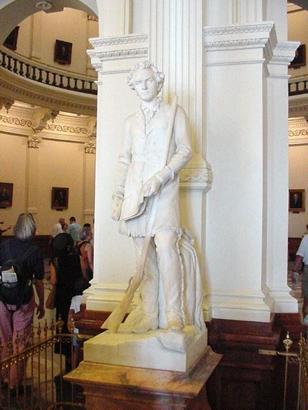
Stephen Austin’s
next step was to travel to New Orleans and begin recruiting colonists.
The success of his colony would rest in part on the settlers he
selected. By the terms of his empresarial grant, the colonists had
to be persons of good character who were either Catholic or would
agree to become Catholic. They also had to pledge their loyalty
to the king of Spain. Almost as important as meeting the terms of
the grant, all prospective settlers had to be willing to accept
hard times at first and be able to provide for themselves.
|
 |
|
Austin’s grant
allowed him to settle 300 families in Texas.
These original colonists would eventually become known as the
“Old Three Hundred.” Settlers who claimed to be farmers would
receive one labor, or 177 acres of land, and those who professed
to raise cattle could obtain an additional sito, or square league
of 4,428 acres. Most colonists qualified for both. Beginning in
1821, colonists began to arrive by land through Nacogdoches
on the El
Camino Real, and by sea on Austin’s small ship, the
Lively. The Baron de Bastrop, as the Spanish government's land agent,
issued titles to the settlers after Austin ensured they were fully
qualified.
During the first year of the colony’s existence, 1822-23, life was
difficult for both Austin and the settlers. Mexico had recently
gained it’s independence from Spain, and Austin was forced to travel
to Mexico City to defend his empresarial grant. For a year, he pleaded
his case before a revolving door of Mexican governments before the
grant was once again approved. Meanwhile, in the colony, a severe
drought devastated the settlers’ crops, and continual raids by the
Karankawa Indians practically brought new emigration to a standstill.
Some families gave up and returned to the United States.
When Austin returned from Mexico in the summer of 1823, the fortunes
of the colony quickly began to improve under his leadership. First,
he organized the militia and drove the Karankawas entirely out of
the colony. The “ranging companies” Austin created were the forerunners
of the Texas Rangers. He then made treaties with the Witchitas and
Tonkawas which effectively ended further horse raids along the Brazos.
While in Mexico, Austin learned to speak Spanish and gained the
trust of Mexican officials. This enabled him to influence the passage
of laws beneficial to the colony like the laws freeing the colonists
from taxes, and granting them homestead rights, so their homes could
never be seized in payment for a debt.
|
 |
|
With the assistance
of the Baron de Bastrop, Stephen
Austin founded his capital, San
Felipe de Austin on the west bank of the Brazos River at
the ferry crossing on the Old San Antonio Road. The Mexican governor
named the settlement to honor both the colony’s empresario and the
governor’s patron saint. Though it remained the center of colonial
activity for many years, San Felipe never grew in relation to its
historical significance. The town was later destroyed by Santa Anna
during the Texas Revolution, and although it was eventually rebuilt,
never regained its importance.
Austin performed many different functions for his colony, including
acting as the settlers’ representative to the Mexican government,
issuing land grants, translating Mexican laws into English, settling
minor disputes, and communicating the government’s latest policies
to the settlers. As empresario, Austin had enormous powers; he was,
in fact, a dictator in all but name only, with the authority to
appoint any official he chose, and to establish all the rules and
regulations he thought necessary to maintain the smooth operation
of the colony.
Since the colony was excused from taxes, church tithes, and customs
duties, the Mexican government had little interest in it. As far
as they were concerned, it was created for the sole purpose of acting
as a buffer between their settlements along the Rio Grande and the
Comancheria. Austin was also commissioned a Lieutenant Colonel in
the Mexican army and served as the military and political commander
of the colony. He was even permitted to develop and codify his own
laws; an awesome power that he seldom exercised and never abused.
|
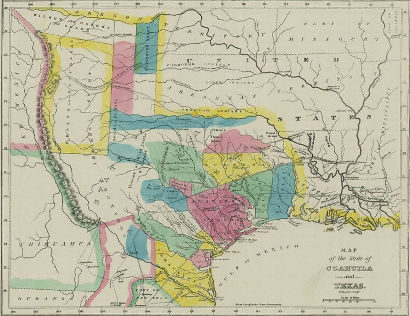 |
Map of Mexican
province of Coahuila and Texas in 1833 showing several land grants.
click
on map for large image. Wikimedia Commons |
| Stephen
F. Austin was far from the only empresario in Texas history. In
1825, the colonization law of the state of Coahuila y Tejas provided
for other individuals to apply for land grants, and by 1830, about
30 men had done so. Even Austin applied for, and was granted, additional
land. The second most important empresario, Green DeWitt, received
his grant in 1825. He founded a colony southwest of Austin’s original
grant with headquarters at the settlement of Gonzales.
De Witt was granted authority to settle 400 families. |
 |
|
A native of
Mexico, Martin de Leon, was another important empresario.
De Leon settled 200 families near the Gulf Coast between the Lavaca
and Guadalupe Rivers and founded the settlement of Victoria.
Arthur Wavell and Ben
Milam received grants in Northeastern Texas. Haden Edwards
also received a large grant near Nacogdoches,
but he lost the land after leading the Fredonian Rebellion. Europeans
like James Hewetson and James McGloin, natives of
Ireland, established colonies along the Nueces River.
Thanks to Stephen
F. Austin, “the Father of Texas,” and other dedicated empresarios,
the population of Texas stood at nearly 20,000 citizens by early
1830, most of them from the United States. In addition, many small
communities emerged in east and south Texas, and San
Felipe, Gonzales,
and Victoria
were now thriving towns. The old settlements of Nacogdoches,
La
Bahia, and San Antonio
had grown considerably. However, before long, the thousands of new
Anglo-American settlers would weary of a Mexican governmental system
that offered very little in the way of personal liberty and basic
human rights, and the stormy winds of revolution would soon begin
to stir across the vast land known as Texas.
© Jeffery
Robenalt
"A Glimpse of Texas Past"
October 1, 2011 Column
jeffrobenalt@yahoo.com
|
|
|
 HOME
HOME