|
|
|
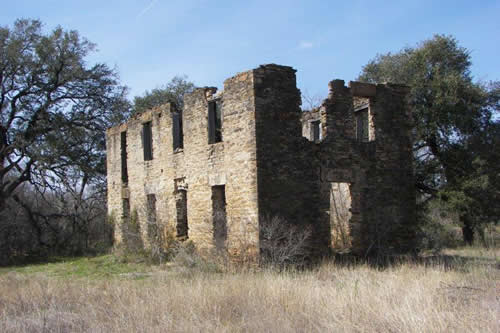
Burnt ruins
of The Benton City Institute & Atascosa Lodge.
ON FM 3175 just a little east of the Benton
City cemetery.
Built in 1875. In use until 1934
Photo Courtesy Terry
Jeanson, February 2010
|
|
History in
a Pecan Shell
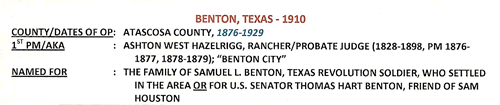
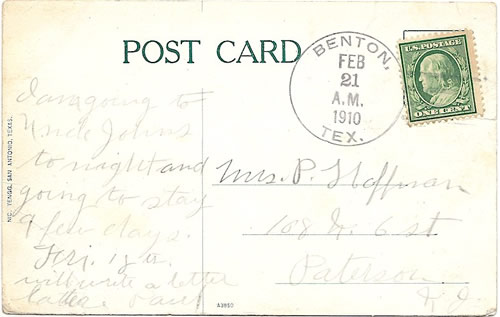
Benton was settled in 1876 and was granted a post office that same
year. It has three possible namesakes. The first was Missouri Senator
Thomas Hart Benton, the second Samuel L. Benton who served at San
Jacinto or possibly one of Samuel Benton’s sons. Since the sons
inherited land in this area, it was likely one of them.
By 1878 the town had a Masonic lodge, the Benton City Institute
and its own newspaper. By 1879 residents of Benton attempted to
form a separate county, but Medina
and Bexar counties
weren’t willing to contribute any of their land for the experiment.
The town suffered
a blow to its collective ego when it was bypassed by the railroad
(the International-Great Northern) in 1881.
By the mid
1880s the population was a mere 50 residents. In 1904 it reported
just over 300 residents, but ten years later it was down to 200.
In 1904 the Benton school employed two teachers to instruct 75 students.
By 1914 there were 104 students, but the high school merged with
the Lytle district in 1919.
The population returned to just 50 residents by the mid 1920s. The
grammar school closed in the mid 1930s and today the ruins of the
Masonic lodge and the city cemetery are all that are left from Benton’s
“golden age.”
|
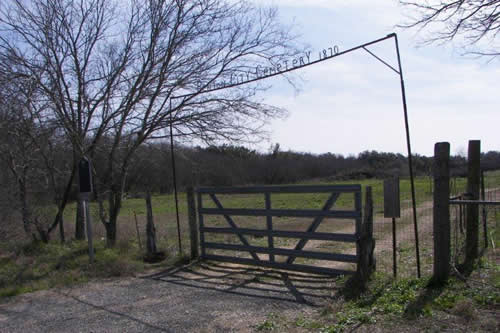 |
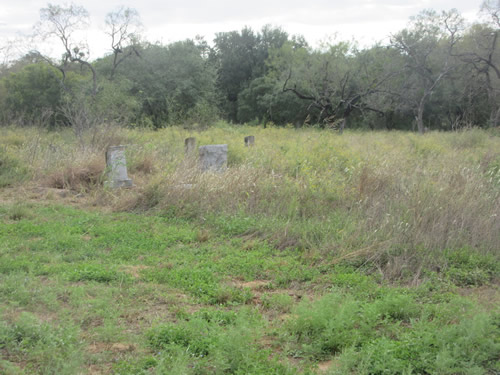
Benton
City Cemetery on FM 3175
right next to the Atascosa Creek.
Photo
courtesy Terry
Jeanson, February 2010 |
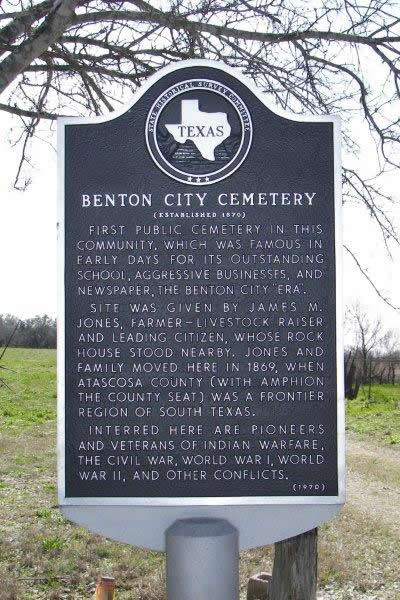
Historical Marker:
Benton City
Cemetery
(Established 1870)
First public cemetery in this community, which was
famous in early days for its outstanding school, aggressive businesses,
and newspaper, the Benton City "Era."
Site was given by James M. Jones, farmer-livestock raiser and leading
citizen, whose rock house stood nearby. Jones and family moved here
in 1869, when Atascosa
County (with Amphion the county
seat) was a frontier region of south
Texas.
Interred here are pioneers and veterans of Indian warfare, the Civil
War, World War I,
World War II,
and other conflicts. |
Benton
City Cemetery historical marker
Photo courtesy Terry
Jeanson, February 2010 |
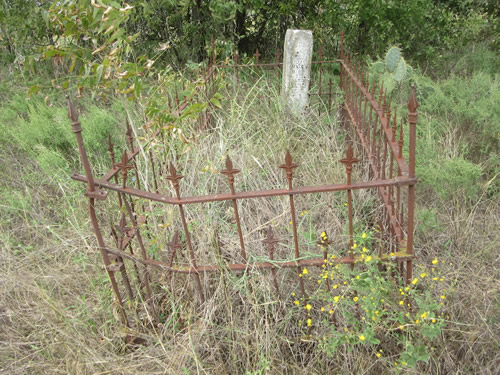
Photographer's
Note:
"I was there in the fall of 2017. We made it thru the city cemetery
gate pictured in your article and found a very sadly overgrown graveyard.
Thought you might want to see these; makes you want to cry."
- John
J. Germann |
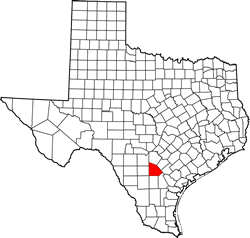
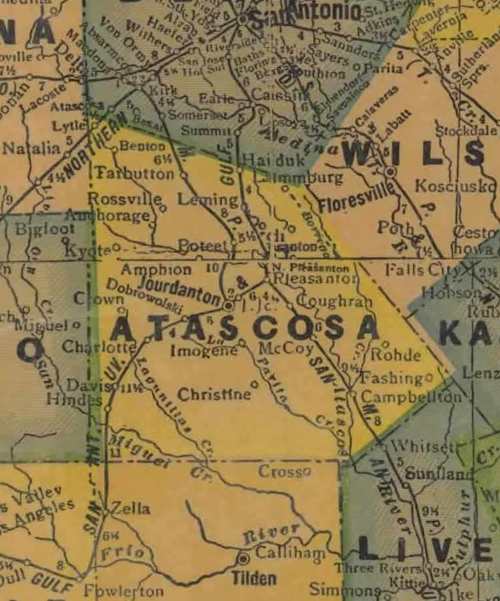
1940s map showing
Benton & Lytle
in Northwestern corner of Atascosa
County
near Medina and
Bexar county lines
From Texas state map #4335
Courtesy
Texas General Land Office |
| Texas
Escapes, in its purpose to preserve historic, endangered and vanishing
Texas, asks that anyone wishing to share their local history, stories,
landmarks and recent or vintage photos, please contact
us. |
|
|
 HOME
HOME

 Texas
Gulf Coast
Texas
Gulf Coast East
Texas
East
Texas Central
Texas North
Central
Texas North Central
Texas South
Central
Texas South Texas
Panhandle
Texas
Panhandle South
Texas
South
Texas Texas
Hill Country
Texas
Hill Country West
Texas
West
Texas Texas
Ghost Towns
Texas
Ghost Towns Texas
Counties
Texas
Counties